
A Beginner's Guide to Competitive Analysis Research
Discover competitors & their strategies with a beginner's guide to competitive analysis research.

In today's world, businesses are always growing and changing because of new technology and lots of competition. People who are starting their own companies or becoming business owners need to be really smart about their plans. One way they can get ahead is by studying what other businesses are doing, which is called competitive analysis research.
This type of research can provide invaluable insights into your competitors' strengths, weaknesses, strategies, and market positioning, enabling you to make better-informed decisions that could ignite your growth and make you a dominant player in your industry. This comprehensive guide will explain each step of conducting competitive analysis research and emphasize its fruitful advantages.
Understanding Competitive Analysis Research
Competitive analysis research is like playing a detective in the world of business. You find out who your main competitors are and look into their plans, strong points, weak areas, and their place in the market. It's a very important step in making your business strategy because it helps you understand the market, who you are competing against, and what your customers want.

For a young person starting a new business, this research can bring a lot of advantages. You can spot trends and patterns in the market, find places that need a product or service like yours, see new chances to grow, and come up with better ways to promote your business.
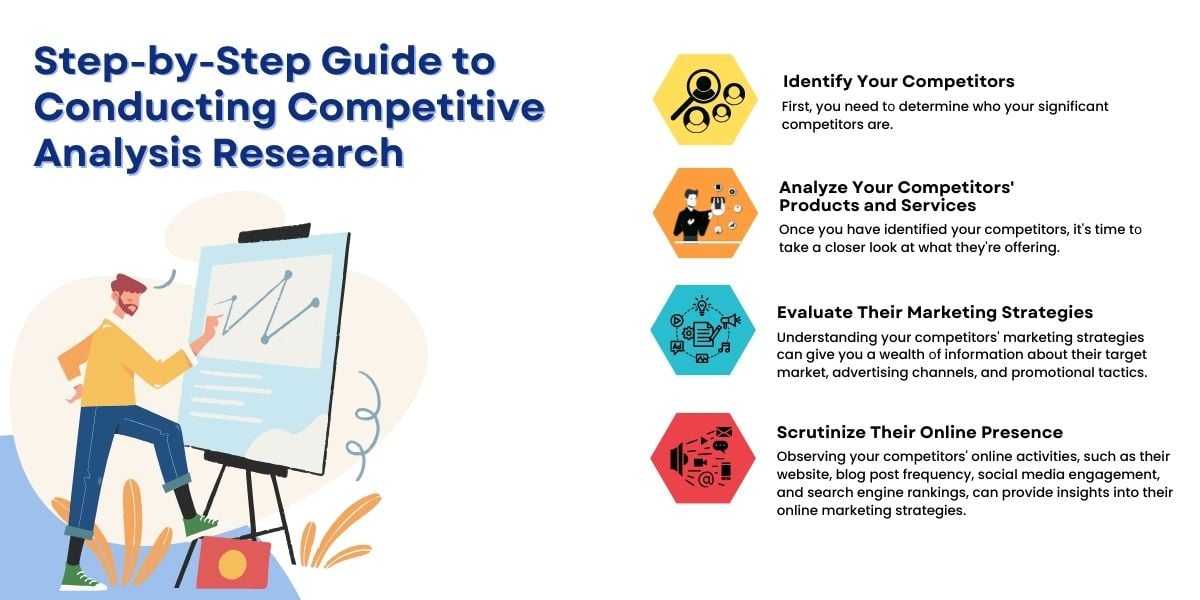
Step-by-Step Guide to Conducting Competitive Analysis Research
Conducting competitive analysis research is a meticulous process that can be broken down into clear steps to facilitate understanding.
Step 1: Identify Your Competitors
First, you need to determine who your significant competitors are. These can be local businesses offering the same services or products, major brands targeting the same keywords on search engines, or even potential competitors who might enter your market.
To effectively identify your competitors, follow these simple steps:
- Begin with a broad search: Using search engines, industry reports, or market research databases to find businesses operating within your industry segment.
- Narrow down to specific areas: Focus on geographical region, target audience, or specialty to locate the most relevant competitors.
- Look for alternative solutions: Keep an eye out for competitors that might be providing a different product or service but fulfilling the same customer needs.
- Monitor the market: Stay updated on new entrants and constantly reevaluate your list of competitors to stay ahead.
Step 2: Analyze Your Competitors' Products and Services
Once you have identified your competitors, it's time to take a closer look at what they're offering. Scrutinize their product or service range, unique selling propositions (USPs), customer reviews, pricing, and other features that stand out.
To thoroughly examine your competitors' offerings, adhere to these systematic recommendations:
- Research product or service descriptions on their websites, in brochures, or on third-party websites.
- Utilize customer reviews on web platforms such as Google My Business, Yelp, or Amazon to obtain unbiased opinions.
- Compare pricing and features between different competitors.
- Study their Unique Selling Propositions (USPs) and any areas where their product or service excels or falls short.
Step 3: Evaluate Their Marketing Strategies
Understanding your competitors' marketing strategies can give you a wealth of information about their target market, advertising channels, and promotional tactics. It can also reveal their key messages and help you understand why customers might choose them over you.
- To assess your competitors' marketing initiatives, adopt the following tactics:
- Monitor their advertising efforts across multiple channels - online, print, and broadcast media.
- Study their social media activities and content to understand their target audience and messaging.
- Browse through their email marketing campaigns, newsletters, or promotional materials.
- Take note of any specific events, sponsorships, or partnerships in which your competitors are involved, which can reveal their target market and overall strategy.
Step 4: Scrutinize Their Online Presence
Observing your competitors' online activities, such as their website, blog post frequency, social media engagement, and search engine rankings, can provide insights into their online marketing strategies.
To delve into your competitors' digital footprint, follow these methodical directions:
- Browse their official websites and pay attention to ease of use, responsiveness, and content quality.
- Observe the blog post frequency, topics covered, and engagement on their site.
- Analyze their social media channels and gauge their followers, engagement, and overall sentiment.
- Use tools like MOZ or Ahrefs to examine their search engine rankings and website traffic.
Armed with information from each of these steps, you will have a comprehensive understanding of your competitors and their strategies. You can then leverage these insights to make informed decisions that will help you stand out from the competition.
Evaluating Competitor Strengths and Weaknesses
Understanding your competitors' strengths and weaknesses can provide invaluable insights. By analyzing their products, pricing, marketing strategies, customer service, and more, you can identify areas where your business could potentially excel and areas where you could improve.
To conduct a comprehensive evaluation of your competitors' strengths and weaknesses, you may follow these steps:
✔ Develop a List of Competitors: Start out by mapping your market and identifying who your direct and indirect competitors are. You can follow the steps mentioned previously in 'Step 1: Identify your Competitors.'
✔ Use a SWOT Analysis: Use this tool to analyze your competitors’ Strengths, Weaknesses, Opportunities, and Threats. It provides an organized framework to methodically assess your competitors.
✔ Analyze their Products or Services: Study the range of products or services they offer. Identify what makes their offerings superior or inferior to yours. This can include a broad array of factors, from product features, quality, customer service to user experience.
✔ Compare Pricing Strategies: Examine their pricing models. Understand if they are positioning themselves as a low-cost provider or if they are charging a premium price for value-added services.
✔ Study their Marketing Strategies: Take a close look at their marketing activities to understand what they are doing to attract and retain customers. Pay attention to their advertising channels, messaging, branding, and even the aesthetics.
✔ Examine their Customer Service: Consider their customer service quality. Customer reviews, rating websites, social media comments can provide firsthand insights about the strengths and weaknesses of their customer service.
✔ Understand their Online Presence: Evaluate their website and social media channels. Identify their SEO strategies, content quality, blogging frequency, social media engagement and use this digital footprint to gauge their internet savviness.
✔ Monitor their Business Activities: Regularly monitor your competitors' business activities for any significant changes. This could be anything from a new product launch, change in leadership, a big client win, or a shift in strategy.
By meticulously evaluating these aspects, you can spot your competitors' strengths and weaknesses, giving you valuable insight into what areas your business could potentially excel in and what areas might need some improvement. It's about learning from others' successes and failures to refine your own strategies in a competitive market.
Analyzing Market Trends and Opportunities
Staying ahead of market trends is critical for business growth. This is where you can identify potential opportunities for your business. Competitive analysis research involves constantly monitoring the market, paying close attention to trends, consumer behaviors, and potential gaps that your business could fill.
Effective analysis of market trends and opportunities encompasses a holistic understanding of industry dynamics, consumer behavior, technological advancements, and socio-economic influences. Here's how you can go about it:
1. Conduct Industry Analysis: Start by understanding the specifics of your industry. Regularly read reports and analysis from industry-specific journals or databases, monitor industry-related news or subscribe to industry newsletters. This could help you understand trends in your industry, including any major shifts or disruptions.
2. Monitor Consumer Behavior: Use surveys, interviews, and feedback to delve into what consumers want. Stay on top of changes in behavior patterns or preferences. Social media monitoring and online forums can be useful tools in learning more about consumer desires and behaviors.
3. Use Market Research Reports: Leverage market research reports that synthesize vast amounts of data into actionable insights. These reports often provide a comprehensive view of market trends, future forecasts, emerging technologies, and untapped opportunities.
4. Stay Current with Technological Advances: In today’s technology-driven world, staying up-to-date with the latest technologies can provide a competitive edge. Understand what technologies are being adopted in your industry and see how they might influence trends and opportunities.

5. Evaluate Socio-economic Factors: Understanding socio-economic factors like population growth, economic trends, cultural changes, or legislative updates can help in the identification of potential opportunities.
6. Perform a Gap Analysis: Identify the gaps in the market that your competitors are not serving. This includes underserved customer needs or demand for a service/product that isn’t adequately served by existing businesses.
7. Be Vigilant of Competitors’ Activities: Keep an eye on your competitors. What they’re doing well might be a trend you can adopt. Their failures might indicate pitfalls to avoid, and their blindspots could be opportunities for you.
By staying updated with these influential aspects, you can adapt to the changing environment, proactively implement necessary modifications, and exploit untapped market opportunities.
Investigating Competitor Collaboration and Partnerships: A Vital Facet of Competitive Analysis Research
Strategic partnerships and collaborations can significantly impact a company's growth and sustainability. As part of competitive analysis research, investigating your competitors' alliances can provide invaluable insights into their strategy, expanding your understanding of your competition and the broader market dynamics. Here's a step-by-step guide to conducting this crucial research.
Why Investigation is Crucial ?
Partnering with other firms allows companies to acquire additional resources, tap into supplementary expertise, and drive innovation. These collaborations often lead to products and services that could disrupt markets or redefine industry standards. Thus, a firm understanding of your competitors' partnerships can inform your strategic planning and help you anticipate potential market transformations.
How to Investigate Competitor Collaborations and Partnerships
🟨 Identify Your Competitors' Partners
The first step is to identify who your competitors are collaborating with. This could range from other businesses, educational institutions, research organizations, to manufacturing partners. Their annual reports, press releases, and news articles are great sources to fetch this information.
🟨 Understand the Nature of the Partnership
Next, dig deeper to understand the nature of these collaborations. Are they developing a new product line, accessing new markets, or leveraging shared resources? Are these partnerships strategic alliances, joint ventures, or acquisition-based? Understanding the motivation behind these collaborations can give important insights into your competitors' strategies.
🟨 Assess the Impact of the Partnership
Evaluate the actual or potential impact of these collaborations. Have these partnerships resulted in innovative products, improved market share, or greater brand visibility for your competitor? Have they extended their reach or diversified their product offering thanks to these partnerships?
🟨 Watch for New Partnerships and Collaborations
Keep a vigilant eye for new collaborations and partnerships your competition may be forming. News alerts, industry newsletters and following your competitors' social media accounts can help you stay updated about their latest strategic moves.
🟨 Leveraging the Findings
By investigating your competitors' collaborations and partnerships, you can glean several strategic inputs:
- Identifying Potential Partners:
If certain types of partnerships are recurring across your competition, it may reflect industry trends that you might benefit from.
- Spotting Opportunities:
Uncovering a need for a particular resource or expertise across your competitors' partnerships could reveal a gap that your company could potentially fill.
- Strategic Planning:
Understanding the key drivers and outcomes of competitor collaborations can aid in crafting your company's partnership strategy.
Investigating competitor collaborations and partnerships is a powerful tool in the realm of competitive analysis research. By understanding the alliances your competitors are forming, you are not just tracking their growth, but also discovering opportunities for your own business to innovate, grow, and succeed in the competitive marketplace.
Overcoming Challenges in Competitive Analysis Research
Competitive analysis research can throw some stumbling blocks your way. But with the right strategies, you can easily overcome these challenges.
Facing issues such as industry jargon, inadequate data, or resource constraints? Not to worry. You can always rely on paid online tools, business databases, industry reports, and more to help streamline your research process.
Competitive analysis research is a powerful tool for entrepreneurs in the general industry, offering pivotal insights that can pave the path to success. By meticulously understanding the competition, their strategies, strengths, weaknesses, and market positioning, you can craft a formidable business strategy that aligns with emerging market trends, effectively filling gaps within the industry and overcoming challenges.
In the words of the great Michael Porter, "Competitive strategy is about being different," and effective competitive analysis research is the key to finding that unique path.
Discover the Right Tools for Your Startup
Take our 2-minute quiz to find tools tailored to your specific needs and goals.
Take the QuizTakes only 2 minutes


