
Business Planning Definition: Entrepreneurial Mastery
Learn about the fundamentals of business planning, its key components, and effective implementation strategies for long-term success as an entrepreneur or new business.

Looking to start a new business venture? One crucial step that often gets overlooked is business planning. In this article, we will dive deep into the world of business planning, exploring its purpose, benefits, key components, and effective implementation strategies. Whether you are an aspiring entrepreneur or someone looking to set up a new business, understanding the fundamentals of business planning is essential for long-term success.
Defining Business Planning
Business planning refers to the strategic process of creating a detailed roadmap for your business. It involves analyzing your objectives, determining the best course of action, and outlining the steps needed to achieve your goals. This comprehensive plan serves as a guide for decision-making, resource allocation, and overall business management.
Purpose and Benefits of Business Planning
A well-crafted business plan serves several important purposes.
✓ It provides clarity and direction for your business: By clearly defining your objectives, target market, and competitive landscape, you gain a better understanding of the market dynamics, helping you make informed decisions.
✓ It helps identify potential challenges and opportunities while providing a framework for effective risk management: By analyzing market trends and conducting a SWOT (Strengths, Weaknesses, Opportunities, and Threats) analysis, you can identify both internal and external factors that may impact your business. Armed with this knowledge, you can proactively address challenges and capitalize on opportunities.
Case Study: Oasis Tech Solutions
Consider the success story of Oasis Tech Solutions, a software development startup. The founders, Susan and David, recognized the need for efficient project management tools within the industry but faced intense competition. To overcome this challenge, they developed a comprehensive business plan. This plan helped them gain a thorough understanding of their target market, allowing them to create innovative solutions tailored to their customers' needs. Today, Oasis Tech Solutions is a leading player in the industry.
Key Components of Business Planning
A business plan typically consists of the following key components:
📓 Executive summary: This section provides an overview of your business, highlighting its mission, vision, and key objectives.
Example of an Executive Summary:✍🏼
[Company Name] is a leading provider of [products or services] to [target market]. Our mission is to [mission statement]. We are driven by a vision of [vision statement]. Our key objectives are to:
[Objective 1]
[Objective 2]
[Objective 3]
We are confident that we can achieve our objectives by leveraging our [key strengths]. We have a strong team of experienced professionals, a deep understanding of our target market, and a proven track record of success.
We are committed to providing our customers with the highest quality [products or services] and to exceeding their expectations. We believe that our strong customer focus and our commitment to innovation will allow us to continue to grow and prosper in the years to come.
Key Financial Highlights
[Revenue]
[Profitability]
[Market share]
Investment Highlights
[Unique product or service offering]
[Experienced management team]
[Strong track record of success]
[Large and growing market]
Conclusion
[Company Name] is a well-positioned company with a bright future. We are confident that we can achieve our objectives and create significant value for our investors.

📓 Company Description: Here, you will provide a detailed overview of your company, including its legal structure, history, and ownership.
Company Description
Company Name: [Company Name]
Legal Structure: [Legal Structure]
Date Founded: [Date Founded]
Headquarters: [City, State]
Ownership: [Ownership Structure]
Mission Statement: To provide [products or services] that [mission statement].
Vision Statement: To be the leading provider of [products or services] in the [industry].
Company History:
[Company Name] was founded in [year] by [founder(s)]. The company started with a small team of employees and a focus on [original focus]. Over the years, [Company Name] has grown to become a leading provider of [products or services] to [target market]. The company has a strong track record of innovation and has been recognized for its commitment to quality and customer service.
Ownership:
[Company Name] is a [ownership structure]. The company's [ownership type] is [name of owner(s)].
Products and Services:
[Company Name] offers a wide range of [products or services]. The company's products and services are designed to [product or service benefits].
Target Market:
[Company Name]'s target market is [target market]. The company's products and services are marketed to [target market demographics].
Key Strengths:
- [Key strength 1]
- [Key strength 2]
- [Key strength 3]
Competitive Advantages:
- [Competitive advantage 1]
- [Competitive advantage 2]
- [Competitive advantage 3]
Financial Performance:
[Company Name] is a profitable company with a strong financial performance. The company's revenue has been growing steadily in recent years.
Future Outlook:
[Company Name] is optimistic about the future. The company is planning to expand its product line and enter new markets. The company is also committed to investing in research and development to maintain its competitive edge.
Conclusion:
[Company Name] is a well-positioned company with a bright future. The company has a strong track record of success, a committed team of employees, and a clear vision for the future. [Company Name] is poised to continue to grow and prosper in the years to come.
📓 Market Analysis: Conduct an in-depth analysis of your target market, identifying segments, target customers, and competition.
For example, if you are planning to open a coffee shop in a specific neighborhood, your market analysis would involve conducting research on the local coffee market. You would analyze the demographics of the area, such as the age range, income level, and lifestyle preferences of the residents. This information would help you identify your target customers and tailor your offerings to their needs and preferences.
📓 Product or Service Offering: Describe your offerings, highlighting their unique selling points and value propositions.
For example, if you are planning to start a bakery business, your product or service offering description would focus on the unique selling points and value propositions of your bakery. You might highlight that your bakery specializes in artisanal bread made from locally sourced ingredients, offering a unique and flavorful experience for customers.
Additionally, you may emphasize that your bakery offers a wide variety of gluten-free and vegan options to cater to customers with dietary restrictions or preferences. These unique selling points and value propositions set your bakery apart from competitors and attract customers seeking high-quality, specialized baked goods.
📓 Marketing and Sales Strategies: Outline your marketing and sales strategies, detailing how you plan to attract and retain customers.
For example, if you are planning to open a fitness studio, your marketing and sales strategies would outline how you plan to attract and retain customers. You might consider offering a free trial period or discounted introductory packages to attract new customers. Additionally, you may plan to host community events or collaborate with local businesses to increase brand awareness and reach a wider audience.
To retain customers, you might implement a referral program where existing members receive incentives for bringing in new customers. Additionally, you could focus on creating a positive and engaging customer experience by offering personalized workout plans, regular progress tracking, and hosting member-only events.
Your marketing and sales strategies might also include digital marketing efforts, such as social media campaigns, targeted email marketing, and search engine optimization, to increase your online visibility and attract potential customers. By outlining these strategies in your business plan, you demonstrate your proactive approach to attracting and retaining customers, ultimately driving the success of your fitness studio.
📓 Operations and Management: Provide an overview of your organizational structure, including key roles and responsibilities.
For example, if you are planning to start a small software development company, your business plan would outline the operations and management of your organization. You would provide an overview of your organizational structure, including key roles and responsibilities.
In this section, you might specify that you will be the founder and CEO, responsible for overall strategic direction and decision-making. You may also mention that you will hire a team of software developers who will be responsible for coding and programming tasks.
Other key roles and responsibilities could include a project manager who will oversee the execution of client projects, a sales and marketing manager responsible for generating leads and closing deals, and an operations manager who will handle administrative tasks and ensure smooth day-to-day operations of the company.
By providing an overview of the organizational structure and key roles, you demonstrate that you have thoughtfully planned the distribution of responsibilities and have a clear understanding of how each team member contributes to the success of your business. This section of the business plan helps investors and stakeholders understand the management and operations of your company.
📓 Financial Projections: This section contains financial forecasts, including sales projections, profit and loss statements, and cash flow analysis.
-Sales Projections: In this section, we forecast our sales figures for the next five years based on market research, historical data, and anticipated growth. For example, we project a 20% increase in sales for the first year due to our expanded product line and aggressive marketing campaign.
- Profit and Loss Statements: This subsection provides a detailed breakdown of our expected revenue, cost of goods sold, and operating expenses. We estimate a 15% increase in revenue year-over-year, while closely monitoring our cost structure to maintain a healthy profit margin of 10% throughout the planning period.
- Cash Flow Analysis: Here, we analyze the inflows and outflows of cash to understand our business's financial liquidity. By considering factors such as accounts receivable, accounts payable, and inventory turnover, we project a positive cash flow that will allow us to invest in new assets, pay off debts, and reinvest in the business for future growth.
Tips for Effective Business Planning and Implementation
✔️ Set realistic goals: Ensure that your objectives are measurable, achievable, and time bound. Setting ambitious yet attainable goals promotes focused growth.
Instead of aiming to increase sales by 100% in the first month, a more realistic and achievable goal could be to increase sales by 20% within the first six months.
✔️ Conduct thorough research:Invest time and effort into researching your market, competitors, and target customers. This knowledge will help you refine your offerings and identify unique selling points.
Before launching a new product, research the market to identify customer needs and preferences. This will help you tailor your product features and marketing strategies to better meet customer demands.
✔️ Regularly review and update your plan:Business plans are not set in stone. Regularly review and update your plan to adapt to changing market conditions and take advantage of emerging opportunities.
If you notice a decline in sales due to changing market conditions, you can update your marketing tactics or product offerings to adapt and regain customer interest.
✔️ Seek feedback:Consider inviting external experts or mentors to review your plan. Their fresh perspective can shed light on potential blind spots and provide valuable insights.
Inviting industry experts or mentors to review your business plan can provide valuable insights and suggestions for improvement. They may notice areas that need more attention or potential opportunities that you may have overlooked.
✔️ Take action: Implement your plan and take the necessary steps to achieve your goals. This includes developing a timeline, assigning tasks, and tracking progress along the way.
Implementing your plan may involve hiring additional staff, launching a new marketing campaign, or investing in new technology to streamline your operations and improve efficiency.
✔️ Allocate resources effectively: Make sure you have the necessary resources, such as funding, personnel, and technology, to implement your plan. Allocate these resources strategically to maximize their impact.
✔️ Continuously learn and adapt: Stay open to new ideas, trends, and industry changes. Continuously learn and adapt your business plan to stay relevant and competitive in the market.
Common Mistakes in Business Planning
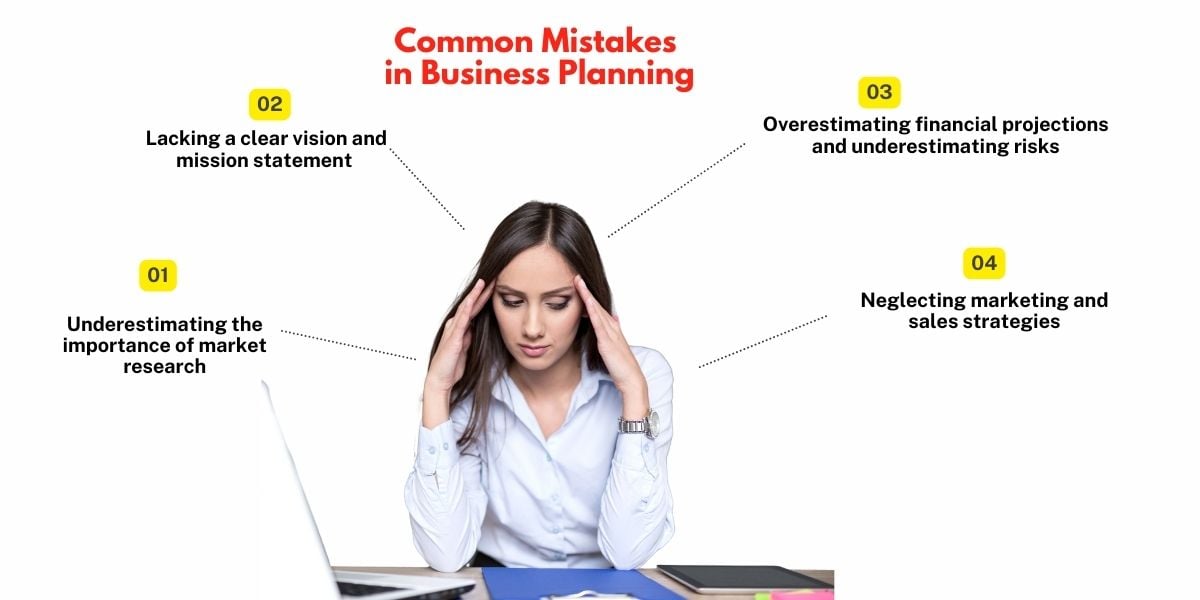
1. Underestimating the importance of market research:
Consequences:
- Misaligned business strategies and product offerings
- Ineffective marketing campaigns and customer acquisition efforts
- Failure to identify potential market opportunities and threats
Practical Tips:
- Conduct thorough market research to understand customer needs, preferences, and competitor landscape.
- Analyze market trends, industry insights, and economic factors that may impact your business.
- Utilize market research tools and resources, such as surveys, focus groups, and industry reports.
2. Lacking a clear vision and mission statement:
Consequences:
- Unclear direction for the business, leading to confusion and wasted resources.
- Difficulty in motivating employees and attracting investors.
- Inability to effectively communicate the company's value proposition to customers.
Practical Tips:
- Clearly define your company's vision, outlining its long-term aspirations and goals.
- Articulate your company's mission, explaining its purpose and what it aims to achieve.
- Ensure that your vision and mission statements are concise, memorable, and aligned with your company's values.
3. Overestimating financial projections and underestimating risks:
Consequences:
- Unrealistic expectations leading to financial strain and potential failure.
- Inability to meet financial obligations and commitments.
- Lack of preparedness for unforeseen expenses and market downturns.
Practical Tips:
- Conduct thorough financial analysis and forecasting, considering various scenarios and potential risks.
- Seek guidance from financial experts and advisors to assess your financial projections.
- Build in contingency plans to address unexpected events and financial setbacks.
4. Neglecting marketing and sales strategies:
Consequences:
- Difficulty in reaching target customers and generating sales.
- Ineffective brand awareness and marketing campaigns.
- Failure to establish a strong customer base and drive revenue growth.
Practical Tips:
- Develop comprehensive marketing and sales strategies tailored to your target market.
- Utilize a variety of marketing channels, including digital marketing, social media, and public relations.
- Implement effective sales techniques and customer relationship management (CRM) systems.
5. Failing to adapt and update the business plan:
Consequences:
- Inability to respond to changes in market conditions, customer preferences, and competitive landscape.
- Rigidity in business operations, hindering innovation and growth opportunities.
- Failure to capitalize on emerging trends and adapt to new challenges.
Practical Tips:
- Regularly review and update your business plan to reflect current market trends and company growth.
- Be open to feedback and suggestions from employees, stakeholders, and industry experts.
- Embrace agility and adaptability in your business strategies to respond to dynamic market conditions.
Securing Funding through Business Planning
One significant benefit of business planning is its role in securing funding. Investors and lenders are more likely to invest in or lend to businesses with a well-prepared business plan, as it reflects a strong commitment to success and a thorough understanding of the market.
A comprehensive plan that includes financial projections, market analysis, and strategies for growth increases your credibility and enhances your chances of securing the necessary funding to fuel your business's growth.
Business planning is an indispensable tool for entrepreneurs and new businesses. By defining your goals, analyzing the market, and creating a well-structured plan, you set the stage for long-term success.
Remember, successful implementation requires continuous refinement and adaptation to changing market conditions. Embrace the power of business planning, and watch your entrepreneurial dreams turn into a flourishing reality.
Discover the Right Tools for Your Startup
Take our 2-minute quiz to find tools tailored to your specific needs and goals.
Take the QuizTakes only 2 minutes


