
Customer Segmentation Definition: Entrepreneur's Guide
Explore the art of customer segmentation in our comprehensive guide. Learn how to overcome challenges, stay updated on trends, and implement effective strategies.

In today's highly competitive marketplace, entrepreneurs and new business ventures face a daunting task of attracting and retaining customers. Being successful means understanding your customers' desires and preferences. One way to do this is by dividing them into groups based on their different needs and preferences. This is called customer segmentation.
In this comprehensive article, we will explore the definition of customer segmentation, its benefits, implementation methods, associated challenges, and emerging trends. By the end, entrepreneurs will gain practical insights and best practices to effectively utilize customer segmentation in their businesses.
Defining Customer Segmentation
Customer segmentation is when businesses divide a large group of people who might be interested in their product into smaller groups based on things they have in common, such as their preferences or behaviors. This helps the business figure out what their customers want so they can make their products or advertising better. By classifying customers into smaller segments, entrepreneurs can create more personalized and targeted approaches, ultimately increasing customer satisfaction and profit-making.

Customer segmentation is the process of dividing a customer base into groups of individuals that share similar characteristics. These groups can be based on demographics, such as age, gender, and location, as well as behavioral characteristics, such as purchase history, website usage, and social media activity. Once companies have identified their customer segments, they can develop targeted marketing campaigns that are more likely to resonate with each group.
How to segment your customer base
There are several ways in which customers can be segmented, such as:
🔘 Demographic Segmentation
This is the simplest and most widely used form of segmentation. It segments customers based on demographic data such as age, gender, occupation, marital status, income, and education level.
🔘 Geographic Segmentation
This form of segmentation divides customers by location, such as by city, region, or country. It could also be as specific as neighborhood or as broad as continent.
🔘 Psychographic Segmentation
This type goes deeper into understanding customers by segmenting them based on their lifestyle, personality traits, interests, attitudes, and values.
🔘 Behavioral Segmentation
This segmentation looks at the way customers interact with a business or product. It includes things like customer's buying habits, product usage, level of loyalty, and benefits sought.
🔘 Needs-Based Segmentation
Customers might be segmented based on their specific needs or wants. Trying to cater to customers' particular needs can lead a business to unprecedented success.
As an entrepreneur, employing customer segmentation allows you to:
✔ Design and launch effective marketing campaigns that resonate with your target audience.
✔ Develop and enhance products and services that cater specifically to the needs and wants of your customer segments.
✔ Improve customer service and ultimately increase customer satisfaction and loyalty.
✔ Better allocate your resources, thus increasing overall efficiency and profitability.
Additionally, coupling customer segmentation with the latest trends such as predictive segmentation, micro-segmentation, and artificial intelligence can help entrepreneurs stay ahead of the competition in today's dynamic and fast-paced business environment.
Benefits of Customer Segmentation for Entrepreneurs
Implementing customer segmentation provides numerous benefits for entrepreneurs starting a new business venture. This topic is about making marketing strategies better. Instead of using the same strategy for everyone, companies find the most promising customers and focus on them. This helps them make more money on their marketing investments.
Additionally, customer segmentation helps entrepreneurs create more compelling and relevant marketing messages, leading to higher customer engagement and improved conversion rates. Moreover, by accurately understanding customer preferences, businesses can offer customized products or services, resulting in increased customer loyaltyand repeat business.
By understanding their customers' needs and preferences, businesses can:
✅ Increase sales: Targeted marketing campaigns are more likely to convert leads into customers.
✅ Improve customer satisfaction: By providing customers with products and services that meet their specific needs, businesses can improve customer satisfaction and loyalty.
✅ Reduce marketing costs: By focusing their marketing efforts on the most promising customer segments, businesses can save money on marketing costs.
Tips for Effective Customer Segmentation
Creating a successful customer segmentation strategy requires careful planning and a deep understanding of your target audience. Here are some tips to help you develop an effective approach and make the most of your customer segmentation efforts:
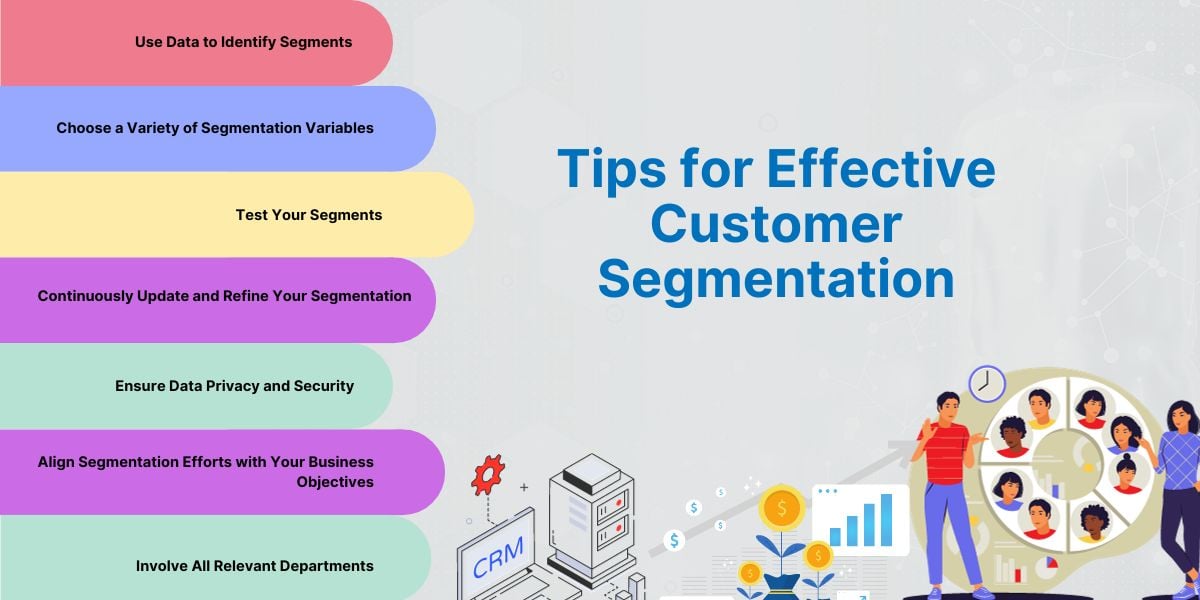
☑️ Use Data to Identify Segments
Leverage data from various sources to identify customer segments. Combining data from your CRM system, website analytics, social media accounts, and other platforms will help you gain a more comprehensive understanding of your customer base and create effective segments.
☑️ Choose a Variety of Segmentation Variables
Avoid relying on just one or two segmentation variables, such as age or income. Instead, use a range of variables incorporating demographic, geographic, behavioral, and psychographic factors to create a well-rounded and detailed view of your customer base. This approach enables you to design targeted and personalized marketing campaigns that resonate with customers on multiple levels.
☑️ Test Your Segments
After identifying your customer segments, validate them by testing targeted marketing campaigns and measuring the results. Monitor key performance indicators (KPIs), such as conversion rates, engagement, and ROI, to assess the success of your campaigns. Adjust your segmentation approach based on the insights you gain from these tests.
☑️ Continuously Update and Refine Your Segmentation
Customer preferences, needs, and behaviors can change over time. Regularly update and refine your segmentation to ensure it remains relevant and effective. Utilize real-time data and adopt a dynamic approach that allows you to make adjustments as needed.
☑️ Ensure Data Privacy and Security
With increased data collection and analysis comes the responsibility of protecting your customers' privacy and securing their information. Comply with data protection regulations like GDPR and CCPA to demonstrate your commitment to customer privacy. Develop a solid data management framework that includes encryption, secure storage, and proper data handling processes.
☑️ Align Segmentation Efforts with Your Business Objectives
Your customer segmentation strategy should align with your overall business goals and objectives. Whether your focus is on customer retention, acquisition, or increasing revenue, ensure that your segmentation efforts support those goals and contribute to your overall business strategy.
☑️ Involve All Relevant Departments
Effective segmentation requires cross-functional collaboration. Ensure that all relevant departments, such as marketing, sales, customer service, and product development, are involved in the segmentation process and are using the insights generated to make informed decisions and enhance customer experiences.
By following these tips, you can build a strong foundation for your customer segmentation strategy and optimize your marketing efforts. Ultimately, understanding your customers' distinct needs and preferences through effective segmentation will empower you to attract, engage, and retain a loyal customer base.
Customer segmentation tools
There are a number of customer segmentation tools available that can help you identify and analyze your customer segments. Some popular tools include:
- SAS Customer Segmentation: A powerful tool that can be used to segment large customer bases.
- IBM SPSS Modeler: A data mining tool that can be used to identify patterns in customer data.
- Alteryx Segmentation: A self-service tool that is easy to use for businesses of all sizes.
Customer segmentation examples
Here are a few examples of how customer segmentation can be used:
- A clothing retailer could segment its customer base by age and gender. This would allow the retailer to create targeted marketing campaigns for each segment, such as sending emails about new arrivals to young women or offering discounts to senior citizens.
- A grocery store could segment its customer base by purchase history. This would allow the store to send targeted coupons to customers who frequently purchase certain items.
- A travel company could segment its customer base by interests. This would allow the company to send emails about travel packages that are relevant to each segment, such as sending emails about beach vacations to customers who have expressed an interest in sunbathing.
Customer segmentation is an essential tool for any business that wants to succeed in today's competitive marketplace. By understanding their customers' needs and preferences, businesses can develop targeted marketing campaigns that are more likely to resonate with each group. This can lead to increased sales, improved customer satisfaction, and reduced marketing costs.
Challenges and Solutions for Customer Segmentation
While customer segmentation offers considerable value to businesses aiming to better understand and serve their target audience, no process is without its hurdles. Recognizing potential challenges and finding innovative solutions is a crucial part of any robust customer segmentation strategy. Below, we explore some of these difficulties and how to tackle them.
🔥 Challenge 1: Data Collection
The primary challenge faced by many businesses is gathering adequate customer data for segmentation. Without a variety of data points, customer segmentation can become impossible.
Solution: Leverage various data collection methods, from online surveys and newsletters sign-ups to transaction histories and customer feedback. Using comprehensive Customer Relationship Management (CRM) systems can also support data collection efforts, storing critical customer information in one accessible location.
🔥Challenge 2: Data Accuracy and Consistency
Another significant issue is ensuring that collected data is accurate and consistent, as faulty or inconsistent data can lead to misleading conclusions.
Solution: Regular data audits can help maintain accuracy and consistency in your data. Implementing quality control measures in initial data collection stages, like validation checks in online forms, can also assist in minimizing errors.
🔥 Challenge 3: Rapid Changes in Customer Behavior
Customer behavior and preferences can change swiftly, which could leave existing segmentation models obsolete.
Solution: Adopt continuous and real-time customer segmentation methods and use tools that allow for dynamic data updating. Such an approach helps businesses stay current with shifts in customer behavior.
🔥 Challenge 4: Effectively Implementing Segmentation Insights
Having segmented customer data is one thing, but effectively implementing strategies based on that segmentation is another challenge.
Solution: Ensure there's a comprehensive plan in place to leverage segmentation data. This plan could involve designing personalized marketing campaigns, developing tailored products or services, and training customer service teams to better cater to individual segment needs.
🔥 Challenge 5: Lack of Advanced Analytical Skills
To leverage customer segmentation fully, advanced analytical skills are often necessary, which many businesses may not have in-house.
Solution: Invest in training existing staff in data analysis skills or consider hiring data analysts or scientists. Alternatively, leveraging user-friendly segmentation tools or partnering with data analysis consultants can bridge this gap.
To be successful with customer segmentation, businesses must recognize and address these challenges proactively. It's a journey that involves continuous learning and adaptation but opens up opportunities for improved customer engagement, increased loyalty, and strong business growth. As tools and technologies continue to advance, businesses will find it easier to navigate these challenges, extracting maximum value from their customer segmentation efforts.
Embrace Customer Segmentation for Entrepreneurial Success
Customer segmentation is a powerful tool that can help businesses of all sizes achieve their marketing goals. By understanding their customers' needs and preferences, businesses can develop targeted marketing campaigns that are more likely to resonate with each group. This can lead to increased sales, improved customer satisfaction, and reduced marketing costs.
Using customer segmentation as a growth strategy, entrepreneurs can make more informed decisions and come up with products, services, and marketing initiatives that resonate with their target audience. This is particularly important in the highly competitive landscape we find ourselves in today.
Therefore, the ability to use customer insights to drive key business strategies makes customer segmentation an essential tool for any entrepreneur aiming to achieve sustainable growth.
Additional Resources:
Check out online courses on platforms like Udemy or Coursera that offer specific tutorials and guides on customer segmentation.
There are plenty of books available that dive deeper into the subject, such as "Customer Segmentation and Clustering Using SAS Enterprise Miner" by Terry Woodfield.
Software tools can help automate and streamline the segmentation process. Look into offerings from vendors like HubSpot, Marketo, or Claritas.
Discover the Right Tools for Your Startup
Take our 2-minute quiz to find tools tailored to your specific needs and goals.
Take the QuizTakes only 2 minutes


