
Developing a Powerful Marketing Mix and Plan for Business
Learn to create a strong marketing mix and plan for your business with this ultimate guide. Drive success through strategic marketing.

In the dynamically competitive world of business, effective marketing strategies play an instrumental role in determining a company's success. Amongst these strategies, the marketing mix stands out as a crucial element that permits businesses to carefully plan, manage, and implement their marketing campaigns. This blog post aims to delve into the depth of the marketing mix, providing you with an engaging and informative guide to master this essential strategic tool.
What is the Marketing Mix?
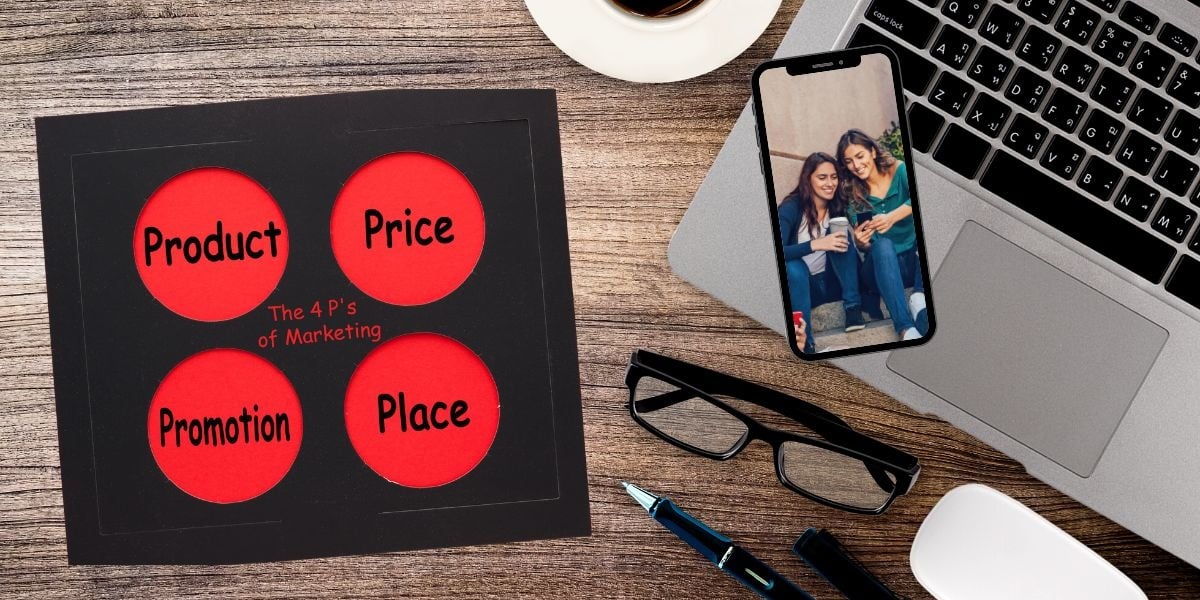
The marketing mix is a concept that encapsulates a company's tactical decisions regarding product offerings, pricing, promotions, and distribution channels. It is often represented through the four Ps of marketing: Product, Price, Promotion, and Place. By skillfully integrating these elements, businesses can successfully control their marketing efforts, tailor them to their target audience, and maximize their chances of overall success.
◽ Product
In this digital era, creating a product that meets consumer needs is only the foundation of a successful business. The product aspect of marketing mix involves determining the features, quality, branding, packaging, and even warranty options. By conducting market research, gathering customer feedback, and analyzing competitors, businesses can continuously improve their product offerings and create a unique selling proposition.
◽ Price:
Pricing strategy is an artful science within the marketing mix. It involves determining the appropriate price to maximize profits while considering consumer perceptions and market conditions. Whether adopting premium pricing, penetration pricing, or value-based pricing, businesses must strike a balance that suits their target market, market positioning, and profitability goals.
◽ Promotion:
Promotion encompasses all forms of communication utilized to build awareness, generate interest, and persuade customers to purchase the product. Through various promotional tools like advertising, public relations, direct marketing, sales promotion, and digital marketing, businesses can effectively reach their target audience, build brand recognition, and gain a competitive edge.
◽ Place:
Place refers to the distribution channels and methods used to bring the products to customers. It involves decisions on where and how the product will be sold, considering factors like physical stores, online platforms, intermediaries, logistics, and inventory management. Adopting an appropriate distribution strategy ensures that the product reaches the right customers in a timely and seamless manner.
Optimizing your Marketing Mix
To leverage the full potential of the marketing mix, businesses can follow these key steps:
☞ Conduct thorough market research to understand customer preferences, market trends, and competitive offerings.
☞ Segment your target market based on demographics, psychographics, and behavior, allowing you to tailor your marketing mix to specific customer segments.
☞ Continuously analyze and improve your product offerings by identifying areas to enhance value, differentiate from competitors, and meet evolving consumer needs.
☞ Create compelling promotional campaigns that utilize diverse channels to effectively reach and engage your target audience.
☞ Regularly review and refine your pricing strategy to align with market dynamics, customer perception, and profitability goals.
☞ Optimize your distribution channels by identifying the most efficient and cost-effective ways to deliver your product to customers.
Mastering the art of marketing mix empowers businesses to craft compelling strategies, optimize resource allocation, and fortify their competitive position. By integrating the four Ps with precision, companies can effectively influence customers' purchasing decisions and achieve long-term success. So, embrace the power of marketing mix, adapt it to your business needs, and witness the transformative force it can bring to your marketing endeavors.
Creating a Strong Product Strategy for Marketing Mix Plan
A well-defined product strategy is the cornerstone of a successful marketing mix plan. It provides the foundation for all marketing efforts, ensuring that the right product is being marketed to the right people in the right way.
What is a product strategy?
A product strategy is a plan that outlines how a company will develop, position, and sell its products or services. It should answer the following questions:
🖊 Who is the target market for the product?
🖊 What are the unique selling propositions (USPs) of the product?
🖊 What is the pricing strategy for the product?
🖊 How will the product be distributed?
🖊 How will the product be promoted?
🖊 A strong product strategy should be based on a deep understanding of the target market, the competitive landscape, and the company's own strengths and weaknesses.
Why is a product strategy important?
A product strategy is important for the following reasons:
✔️ It helps to ensure that products are developed and marketed to meet the needs of customers.
✔️ It helps to differentiate products from competitors.
✔️ It helps to guide marketing efforts and ensure that they are aligned with the overall product strategy.
✔️ It helps to make better decisions about pricing, distribution, and promotion.
How to create a product strategy
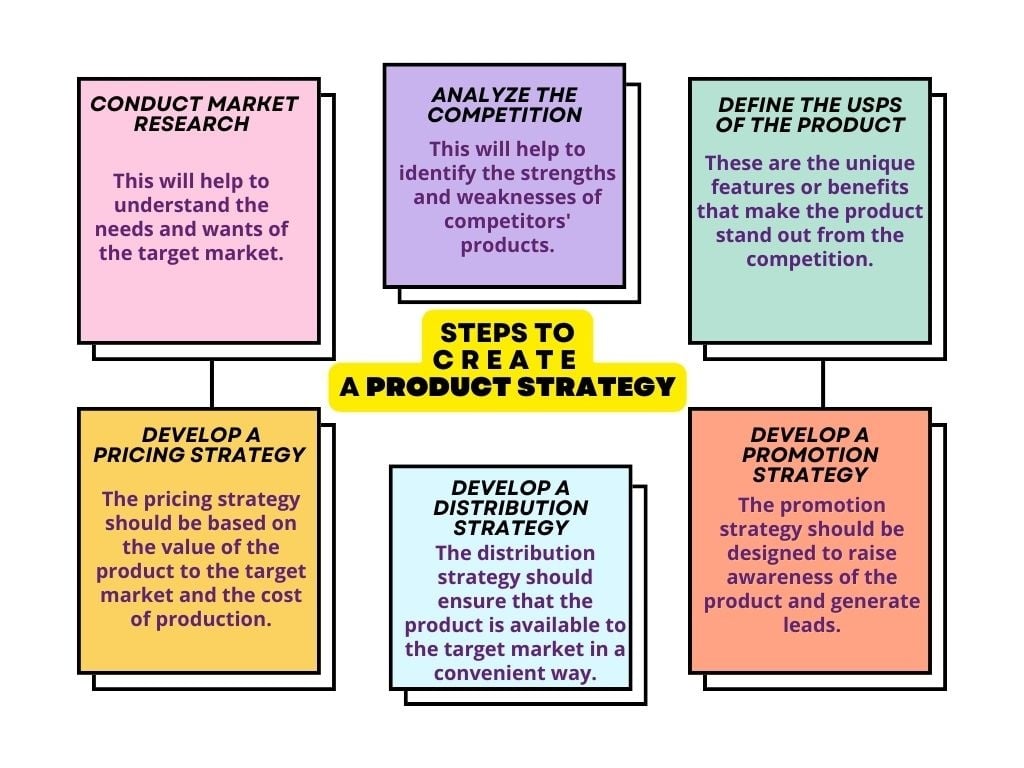
📝 The following steps can be used to create a product strategy:
❶ Conduct market research. This will help to understand the needs and wants of the target market.
❷ Analyze the competition. This will help to identify the strengths and weaknesses of competitors' products.
❸ Define the USPs of the product. These are the unique features or benefits that make the product stand out from the competition.
❹ Develop a pricing strategy. The pricing strategy should be based on the value of the product to the target market and the cost of production.
❺ Develop a distribution strategy. The distribution strategy should ensure that the product is available to the target market in a convenient way.
❻ Develop a promotion strategy. The promotion strategy should be designed to raise awareness of the product and generate leads.
Examples of product strategies
Here are a few examples of product strategies:
🏷️ Apple's product strategy is to focus on high-quality, premium products that are designed to appeal to affluent consumers. The company's marketing efforts are focused on highlighting the unique features and benefits of its products, such as the iPhone's innovative design and the iPad's user-friendly interface.
🏷️ Google's product strategy is to offer a wide range of free products and services that are designed to attract users to its online advertising platform. The company's marketing efforts are focused on promoting its products and services through a variety of channels, such as search engine optimization (SEO) and social media marketing.
🏷️ Amazon's product strategy is to offer a vast selection of products at competitive prices. The company's marketing efforts are focused on making it easy for customers to find the products they are looking for and making it convenient for them to purchase those products.
Choosing the Right Distribution Channels (Place): Maximizing Sales and Reaching Your Target Audience
When it comes to marketing and selling products or services, distribution channels play a crucial role. These channels serve as a pathway that connects the producers or manufacturers with the end-users or customers. In simple terms, distribution channels are routes through which goods or services travel from the producer to the consumer.
The different types of distribution channels and the advantages they offer to businesses.
1️ Direct Distribution Channel: Straight from the Source
Imagine you made the coolest skateboard ever. You could sell it directly to your friends and classmates, without any middlemen. This is called direct distribution. It means you're in charge of everything from making the skateboard to delivering it to customers.
The direct distribution channel involves selling products directly from the manufacturer or producer to the end-consumer without any intermediaries. This channel can be particularly beneficial for certain businesses as it enables them to have complete control over the entire sales and distribution process.
With direct distribution, businesses can build stronger relationships with their customers, obtain valuable feedback, and customize their offerings to meet specific demands. Furthermore, bypassing intermediaries can result in cost savings and potentially higher profit margins for the business.
Example: An online clothing brand that sells its products exclusively through its website and social media channels is utilizing a direct distribution channel.
2️ Indirect Distribution Channel: When Someone Else Sells Your Products
Imagine you made some delicious cookies and wanted to sell them to your classmates. You could go around to each person's desk and sell them directly, or you could ask your friend who's really popular to help you sell them for you. This is kind of like how companies decide how to get their products to their customers.
When a company sells its products directly to customers, it's called a direct distribution channel. This means the company is in charge of everything from making the product to shipping it to the customer's door.
But sometimes, companies choose to use an indirect distribution channel. This means they use other businesses to help them sell their products. These businesses are called intermediaries or middlemen.
There are three main types of intermediaries:
▪ Wholesalers: These businesses buy products in bulk from manufacturers and then sell them to retailers.
▪ Retailers: These businesses sell products directly to consumers.
▪ Distributors: These businesses are like a mix of wholesalers and retailers. They buy products from manufacturers and sell them to retailers, but they may also sell directly to consumers.
Why Use Intermediaries?
There are a few reasons why companies might choose to use intermediaries:
▪ Reach a wider market: Intermediaries often have established networks and customer bases, so they can help companies reach more customers than they could on their own.
▪ Increase product visibility: Intermediaries can help companies promote their products to a wider audience.
▪ Reduce effort: Using intermediaries can free up a company's time and resources so they can focus on other things, like making new products.
Example: Smartphones
Imagine you made a super cool smartphone. You could sell it directly to customers through your own website, or you could partner with companies like Apple, Samsung, or Google to sell it in their stores. This would be an example of using an indirect distribution channel.
Which Channel is Right for You?
The best distribution channel for a company depends on its unique needs, target market, product nature, and resources. Some companies may use a mix of direct and indirect channels.
The important thing is to choose a channel that will help you reach your target market and sell your products. If you're not sure which channel is right for you, you can talk to a business advisor or do some research online.
The Link Between Marketing Mix and Business Performance
An effective marketing mix plays a pivotal role in driving business performance by:
✔ Enhancing Brand Awareness: A well-defined marketing mix helps create a strong brand identity and increases brand recognition among target consumers.
✔ Boosting Customer Acquisition: By effectively communicating the product's value proposition and targeting the right audience, a company can attract new customers and expand its market reach.
✔ Fostering Customer Loyalty: A consistent and positive customer experience, driven by a well-aligned marketing mix, can lead to increased customer loyalty and repeat business.
✔ Optimizing Sales and Profitability: A marketing mix that resonates with the target market and aligns with the company's objectives can lead to increased sales, revenue, and profitability.
Adapting the Marketing Mix to Market Changes
The marketing mix is not a static concept; it needs to be constantly adapted to keep up with market changes, consumer trends, and technological advancements. This includes:
⚬ Monitoring Market Trends: Continuously researching and understanding market trends, consumer preferences, and competitor activities.
⚬ Evaluating Marketing Effectiveness: Regularly evaluating the effectiveness of current marketing campaigns and making adjustments as needed.
⚬ Embracing Technological Advancements: Staying up-to-date with emerging technologies and incorporating them into marketing strategies to stay ahead of the competition.
⚬ Adapting to Consumer Behavior: Understanding and responding to evolving consumer behavior patterns and preferences.
Fuelling Motivation and Embracing the Marketing Mix in Your Business Blueprint
By effectively implementing and adapting the marketing mix, businesses can navigate the ever-changing business landscape, strengthen their competitive position, and achieve long-term success.
As startups and entrepreneurs, each step of your journey will be filled with multiple highs and challenging lows. Faced with roadblocks—it's crucial to remember your 'why', the original motivation that sparked the inception of your venture.
Even the most daunting obstacles carry valuable lessons, which eventually shape the trajectory of your growth. Be resilient, remain patient, and stay committed to your vision.
A comprehensive marketing plan acts as a blueprint for your startup to achieve your business goals. Your marketing mix, which comprises the 4Ps—Product, Price, Place, and Promotion—form the cornerstone of this plan. Each element of the marketing mix plays a critical role in forming the strategies that guide how your product or service is delivered to the market.
Embracing the marketing mix in your marketing plan equips you with the power to:
✧ Deliver the right product/service that resonates with your target audience needs
✧ Price it appropriately for market competitiveness, enhancing customer perceived value
✧ Choose the best distribution channels to reach your audience successfully
✧ Promote it compellingly to capture attention and persuade potential customers to buy
Developing a marketing plan and integrating a tailored marketing mix may require unwavering dedication and persistent effort, but the rewards are immeasurable.

It's like discovering a hidden treasure chest overflowing with invaluable assets that will transform your marketing endeavors into a resounding success.
In the grand scheme of business success, a well-crafted marketing plan is not just a tool; it's an indispensable companion, a silent partner that tirelessly works alongside you, guiding your every step towards achieving remarkable results.
Discover the Right Tools for Your Startup
Take our 2-minute quiz to find tools tailored to your specific needs and goals.
Take the QuizTakes only 2 minutes


