
How to Determine the Ideal Selling Price for Your Product
Master the art of pricing with invaluable strategies, insights from market analysis and competition study, and motivational wisdom for entrepreneurs. Set the perfect price to ensure your product's success.

In the competitive and fast-paced world of business, setting the right price for your product is essential for success. Many entrepreneurs might initially consider this a simple task – just covering costs and adding a margin, right? However, the process of determining the ideal selling price is both an art and a science, impacting everything from your brand positioning to your financial viability.
This comprehensive guide will illuminate the path towards finding that sweet spot for your product's price, offering actionable guidance designed to help you strategize effectively. With insights into market analysis, cost considerations, and pricing psychology, this is your sales growth guide for achieving winning sales goals through strategic sales strategy and planning.
Conducting Market Analysis: An Engaging Approach
Embarking on market analysis is like being a detective. Your mission is to unravel the tapestry of market demand, customer preferences, and pricing intrigues. Don't just scratch the surface; dive deep to unearth actionable insights that will steer your pricing strategy towards success.
Begin your quest with consumer exploration. Delve into the minds of your potential customers: What desires drive them? What value do they place on the solutions your product provides? Utilize tools such as surveys and focus groups like exploratory probes, sending them into the hidden depths of the market to retrieve the treasure trove of consumer insights.
Leverage robust market research platforms that dissect data with surgical precision, offering you a window into the nuances of price elasticity and buyer personas.

Next, turn your gaze to your competitors. Approach this step with the shrewd analytical eye of a chess master, observing every move on the board. Conduct a thorough review of how akin offerings are priced.
Observe not just the price tags, but the underlying strategies: Are there bundled deals? Seasonal discounts? Loyalty rewards? In the chessboard that is the tech battlefield, for instance, behemoths like Apple and Samsung deftly anticipate and react to each other's pricing maneuvers, a dance of market dominance that shapes the entire industry’s pricing conventions. This is not just about imitation but about understanding the 'why' behind their pricing to discern how to position your product distinctively.
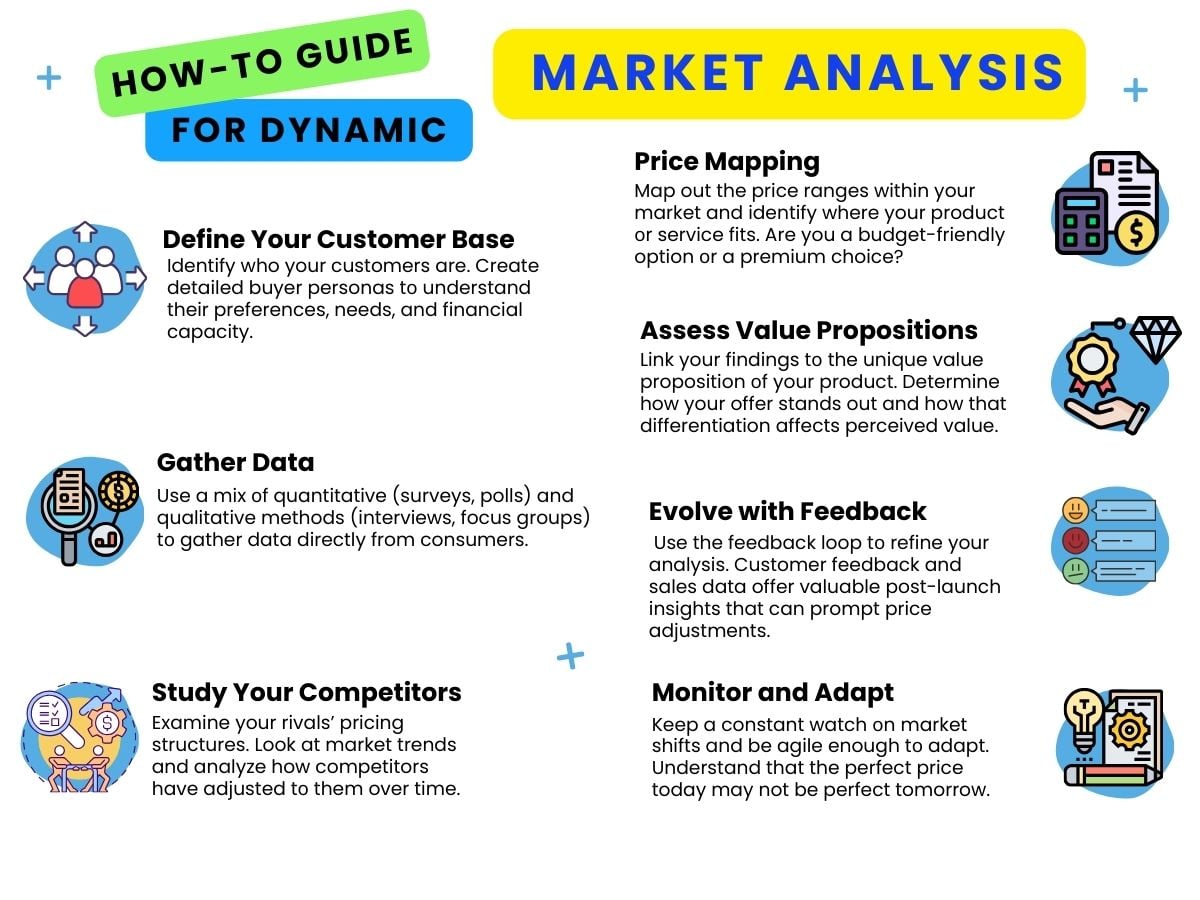
Your Short How-To Guide for Dynamic Market Analysis
✅ Define Your Customer Base: Identify who your customers are. Create detailed buyer personas to understand their preferences, needs, and financial capacity.
✅ Gather Data: Use a mix of quantitative (surveys, polls) and qualitative methods (interviews, focus groups) to gather data directly from consumers.
✅ Study Your Competitors: Examine your rivals’ pricing structures. Look at market trends and analyze how competitors have adjusted to them over time.
✅ Price Mapping: Map out the price ranges within your market and identify where your product or service fits. Are you a budget-friendly option or a premium choice?
✅ Assess Value Propositions: Link your findings to the unique value proposition of your product. Determine how your offer stands out and how that differentiation affects perceived value.
✅ Evolve with Feedback: Use the feedback loop to refine your analysis. Customer feedback and sales data offer valuable post-launch insights that can prompt price adjustments.
✅ Monitor and Adapt: Keep a constant watch on market shifts and be agile enough to adapt. Understand that the perfect price today may not be perfect tomorrow.
With these strategies in your arsenal, proceed with confidence to navigate the interwoven dynamics of market pricing. Imbue your strategy with creativity, backed by solid data and an unyielding commitment to your venture's growth. Your analytical voyage is not just a procedural task; it's a strategic expedition that is pivotal to your business's ascent. Embrace it and let the articulate craft of market analysis sculpt your pricing to perfection.
Understanding Cost Considerations
Pricing procedures require a complete understanding of your cost structure. The first step is to identify every expenditure involved in bringing your product to market. This begins with direct costs: everything it takes to create your product or service, from materials and labor to any outsourced manufacturing or labor fees.
Next, evaluate your indirect costs — also known as overheads. These are not tied to a specific product or service but are essential for running your business. This includes expenses like marketing, rent, utilities, insurance, and administrative expenses.
Once your direct and indirect costs are clear, determine the break-even point for your product — the minimum amount you need to charge to cover all costs and avoid losses. Remember, your selling price needs to cover costs and also contribute to profit margins.
Value Proposition and Its Role in Pricing
Defining your product's unique value proposition is central to successful pricing. Unveiling the power of sales experience, you use this proposition as the driving force behind why customers should choose your product over others. It's a compelling reason — a promise of the value your product holds for the consumer.
Some customers equate higher prices with better quality or enhanced status, like in Rolex or Apple's case. These brands price their products at a premium, pioneering the power of pricing perception to signal high product quality and brand prestige.
However, entrepreneurs must juggle the responsibility of delivering quality without escalating costs, creating an intricate balance. Here is where a strong sales strategy steps in. It visualizes how to keep costs under control while enhancing the product's perceived value, pointing toward a selling price that justifies this value proposition.
Analyzing the Competition for Pricing Insights
Competitive pricing analysis is another critical component of your sales strategy. Gather data about your competitors' prices and use it to guide your pricing strategy. This doesn’t have to lead to a price war. Instead, use this insight to understand where your business stands in the broader market context.
There are many tools on the market, like web scraping or competitive intelligence software, that can aid in this gathering of data, offering insights beyond surface-level price points.
However, competing on price alone is a risky long-term strategy. It's equally crucial to shift your focus away from just price and towards offering superior value. Defeating pricing challenges requires resilience, creativity, and differentiation.
The key is to add unique features or provide exceptional services that justify a higher price point.
This wholistic approach to price determination offers a much stronger foundation for your sales strategy, ultimately leading to a successful business setup.
In the end, leveraging the power of sales experience will not only solidify your business position in the market but also help you create a pricing strategy that leads to sustainable growth.
Applying Pricing Psychology
In mastering the sales process, understanding and using pricing psychology is imperative. It’s a powerful tool that influences consumer behavior and can significantly impact sales figures. The principle of 'charm pricing' employs psychological tricks, like pricing items at $9.99 rather than a round $10. This subtle reduction can lead consumers to perceive the price as being in a lower range, compelling them to make a purchase under the illusion of a better deal.
For example, if you run a café, and you've priced your gourmet sandwich at $10, consider adjusting it to $9.95. Though the difference is merely five cents, the psychological impact is substantial, making the sandwich seem more affordable and increasing its allure.
Another psychological trick is the use of anchor pricing. Present a higher-priced 'anchor' product alongside others to make the rest seem more reasonably priced. For instance, if you sell wine, placing a high-end bottle prominently can make the mid-range bottles appear more attractive to a budget-conscious buyer.
Pricing Strategies and Methodologies
Various pricing strategies and methodologies exist, and selecting the appropriate one is a critical step in mastering the sales process. A cost-plus pricing strategy involves adding a mark-up to the cost of goods sold to ensure a profit margin.
In contrast, value-based pricing reflects how much the customer believes your product is worth, which can often exceed the actual cost of production. For instance, a software company that provides unparalleled customer service might price their product higher than the competition, based on the added value their service provides.
One practical example is the tiered pricing strategy often seen in SaaS businesses. They might offer a basic package at a lower cost to attract entry-level users while providing premium tiers with added features for more advanced users or larger enterprises. For example, a SaaS email marketing service could provide basic email automation at an entry-level price, with premium tiers including advanced analytics and segmentation capabilities for higher prices.
When choosing your strategy, consider your customer's perceived value of your product and your competition's pricing. Your strategy should align with not only your brand's identity but also its long-term vision and goals.
Monitoring and Adjusting Prices
In the dynamic landscape of business, price adjustments are often necessary as part of an ongoing refinement in the sales process. Therefore, consistent market monitoring is crucial once your product is launched. By keeping a keen eye on how the product is performing, which includes analyzing sales trends, customer feedback, and competitor pricing strategies, you can make informed decisions on whether price adjustments are needed.
For instance, if a competitor drops their price and you notice a dip in sales, it might be a signal to reevaluate your own pricing. Monitoring tools and software can help track these changes in real-time, enabling faster response to market shifts.
Regular price audits can also highlight opportunities to optimize your pricing structure. Perhaps a particular product feature is highly valued by customers and could warrant a separate, more premium pricing tier.
As your brand navigates through the complexities of the market, continuously hone your skills in mastering the sales process, from understanding consumer psychology to dynamically adjusting prices. Your pricing decisions should be both data-driven and flexible, allowing for swift adaptation to evolving market conditions, ensuring your business remains competitive and profitable.
Embarking on Your Pricing Journey
Taking a leaf from Kevin Mitchell of the Professional Pricing Society, remember this: "The art of pricing requires you to also be a bit of a seer, looking into the future to determine the potential impacts of your pricing on sales and profit". This insight is as accurate as it gets, highlighting the need for strategic foresight and informed decision-making in price determination.
As budding entrepreneurs and new business owners, let this vibrant blend of information, methodology, and motivational advice guide you through the complex labyrinth of pricing mastery. Remember, defining the perfect selling price is rarely a static process but evolves with your business journey.
Lifelong learning is an entrepreneur's best tool. Be open to the endless lessons each day brings. Adapt your strategies, refine your craftsmanship, and enrich your knowledge as you uncover new facets of the market and consumer behavior. Use the wealth of knowledge gleaned from this guide to approach pricing not with apprehension but as a ripe opportunity to chart out your business's unique success trajectory.

To borrow words from the renowned entrepreneur Steve Jobs, "Stay hungry, stay foolish". Stay curious on this journey, and don’t be afraid to take calculated risks or tackle uncharted areas in the quest of successful price determination.
With a spirit of adventure and resilience, use the wisdom encoded in these words to navigate the intricate dance of setting prices. Your persistence, research, and adaptability will pave your path to the perfect price point – the ideal equilibrium between value and cost.
So, venture forth with courage and tenacity, sharpen your strategies, set your pricing, and conquer your market! From the first sale to the thousandth, the experience of mastering the sales process is one of continuous discovery and growth.
Fuel your entrepreneurial spirit with motivation and equip your business with the power of effective pricing. Forge ahead, fiercely and intelligently, to watch your venture thrive.
Discover the Right Tools for Your Startup
Take our 2-minute quiz to find tools tailored to your specific needs and goals.
Take the QuizTakes only 2 minutes


