
Mastering Business Continuity Planning: Entrepreneurs Guide
Navigate your way through business uncertainties with our comprehensive guide on business continuity planning. Start safeguarding your venture today.

In the dynamic landscape of business, developing a robust plan to withstand potential crisis scenarios is more than a need - it's a duty to your venture. Business continuity planning (BCP) provides entrepreneurs the guidance necessary to weather the storm, pivoting swiftly during unforeseen events to ensure that business operations remain unhampered.
From conducting risk assessments to drafting contingency plans, every aspect plays a crucial role in safeguarding your enterprise's future in an increasingly unpredictable world.
What is Business Continuity Planning?
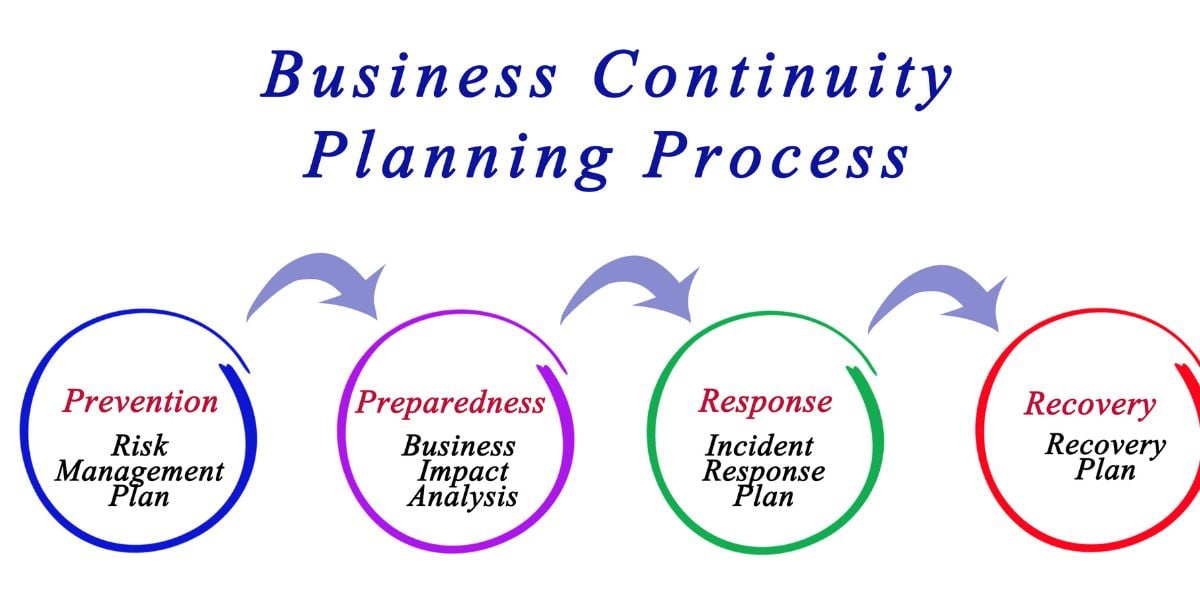
Business continuity planning (BCP) is more than just a lifeline; it's a strategic roadmap to resilience. It comprises predefined protocols that companies formulate to counter significant disruptions. These disruptions, if left unattended, can drastically interrupt operations and lengthen recovery time. The aim of BCP is to bolster resistance against these unforeseen events, ensuring that the rhythm of your business remains unperturbed.
Beyond understanding its definition, mastering business continuity planning requires a comprehensive insight into its integral components, such as risk assessment, contingency planning, and project planning. These elements interweave to form a safety net that protects your venture's present and future. When combined with astute planning and risk management, BCP morphs into a potent weapon safeguarding your enterprise from unpredictable threats.
Risk Assessment: Identifying Vulnerabilities
The domain of business is rife with risks, looming around every corner. No enterprise, irrespective of their scale or industry, is immune to these potential threats. Consequently, risk assessment emerges as an indispensable cornerstone of robust business continuity planning and a quintessential part of master business planning strategies.
Risk assessment involves a meticulously systematic process engineered to scout potential threats and probe vulnerabilities that these threats could potentially exploit. It's akin to conducting a thorough examination of your enterprise's health, zeroing in on weak spots that might compromise its wellbeing.
Just to illustrate, let's consider a software company. One of its risk points could be data privacy breaches. A thorough risk assessment will help the company identify this risk, helping them forge plans to bolster their data security, thereby reducing the likelihood of such breaches.
Whether it's the risk of cybersecurity breaches for a software company or supply chain disruptions for a manufacturing unit, risk assessment arms entrepreneurs with the foresight required to curate proactive plans. This preemptive strategy lowers the chances of the identified risks materializing, ultimately fortifying the business continuity plan.
Contingency Planning: Preparing for the Unexpected
Once you've identified potential risks, it's time to steer your focus towards the second cornerstone of BCP: the contingency plan. Think of this plan as your enterprise's emergency evacuation blueprint, outlining the steps you need to take to safeguard your business during potential crises. It's an integral part of startup business planning, focused on ensuring resilience from disruptions like data breaches to natural calamities.
Developing a contingency plan involves envisioning plausible scenarios resulting from various risks you've identified. For each situation, you need to define the actions necessary for maintaining or quickly resuming critical functions. An effective contingency plan should consider each department in your business, not only those perceived as most vulnerable. Your plan should detail how each sector will respond to disruptions, spanning from production to marketing strategy.
How-to tip:
Start by identifying your most critical business functions that drive revenue or affect your customers the most. Then, consider potential disruptions they may face and strategize effective responses to each scenario. Regularly test and update your contingency plan to account for changing circumstances in your business or environment.
Project Planning: Turning Strategies into Actions
The crux of business continuity planning lies in execution - making contingency plans actionable. That's where project planning comes in, acting as the catalyst that transforms strategies into concrete actions. It's much like assembling a puzzle where each piece represents a task or resource critical to implementing your contingency plans effectively.
Project planning includes defining scopes, setting goals, assigning tasks, scheduling work, allocating resources, and more to realize your strategic vision. It's the engine that drives your contingency initiatives from the drawing board to reality.
How-to tip:
Use project management tools to organize and track tasks. Divide the project into achievable milestones, assign tasks to team members, and set timelines. Regular monitoring and adjustment are also key to ensuring your contingency plan implementation stays on track.
A Practical Scenario
Now, let's bring these concepts to life with a practical scenario. Picture this: You're an entrepreneur who has kick-started a small online store, a dream come to fruition thanks to meticulous startup business planning and a dynamic marketing strategy. But out of the blue, your website succumbs to a cyberattack, leading to significant data loss and disruption of revenue-generating operations.
Yet, you're far from helpless. You'd integrated business continuity planning, and thus, your contingency plan quickly springs into action.
Your prior risk assessment had already tagged cyber threats as a potential risk, and you've had a backup data system in place as per the contingency plan. Despite a temporary setback, your business didn't grind to a halt. Project planning ensured smooth execution of the backup restoration, helping you bounce back sooner than you would have without a BCP.
This scenario underscores the value of comprehensive business continuity planning. It's the shield that guards your business from the ripple effects of unforeseen events, enabling it to thrive amid chaos.
Business Continuity Planning FAQs
Q: Is business continuity planning relevant to small businesses?
A: Absolutely, business continuity planning (BCP) is essential not just for large corporations but for businesses of all sizes, including small-scale ventures. For small businesses, in particular, the impact of operational disruptions can be more severe, given the limited resources at their disposal. Implementing a BCP can be a game-changer, significantly mitigating financial losses and operational hiccups.
Real-life example:
Consider the case of a small local bakery that experienced a significant flood. Thanks to a well-developed BCP, they were able to quickly relocate operations to a temporary site, continue serving their customers, and even fulfill pending orders through partnerships with other local businesses. This not just helped in minimizing financial loss but also in maintaining their brand's trust and loyalty among customers.
Q: How frequently should I update my business continuity plan?
A: A business continuity plan shouldn't be a static document; it needs to evolve alongside your business. Updates should be made whenever there's a significant change in your business model, technology infrastructure, or the regulatory environment that you operate in. It's also wise to review and update your plan annually to ensure it accounts for new threats or vulnerabilities and changes in your business operations. Regular drills or testing of the plan can also highlight areas that need adjustment.
Real-life example:
A tech startup significantly expanded its customer base and transitioned most of its operations online. This shift introduced new cybersecurity risks and data privacy considerations, necessitating updates to their BCP tailored to these new challenges. Regular updates ensured that when a DDoS attack occurred, they were prepared to mitigate the effects swiftly, minimizing downtime and customer impact.
Braving the Storms of Uncertainty: Fortifying Your Business Essence
Uncertainty is a ubiquitous shadow that trails every business venture, lurking in the unpredictable twists and turns of the entrepreneurial journey. Yet, the specter of the unknown need not spell doom for your business aspirations. With a strategic Business Continuity Plan (BCP) in hand, you navigate through ominous waters, harnessing the power of preparedness to transform vulnerabilities into bulwarks of stability.
To aid in the quest of conquering unforeseen challenges, consider these key points each equipped with a real-world example:
✅ Risk Assessment: Conduct thorough risk evaluations regularly to identify and prioritize potential threats.
Example: A coastal hotel regularly assesses hurricane risks and has evacuation plans and property reinforcements ready, ensuring guest safety and business continuity during the season.
✅ Adaptive Strategies: Adapt and evolve your BCP to match the growth and changing facets of your business.
Example: An e-commerce platform revises its BCP to include new cybersecurity measures as it expands its online presence, effectively nullifying a series of potential data breach crises.
✅ Communication Channels: Establish clear, redundancy-proof communication channels to keep your team connected during disruptions.
Example: A financial services firm with a multinational presence implements an encrypted messaging system that maintains communication even when conventional systems fail during a cyber-attack.
✅ Recovery Protocols: Develop tailor-made recovery protocols for various scenarios to ensure rapid restoration of services.
Example: A cloud storage company has automated failovers and data backups in multiple locations, enabling swift recovery when one server facility experiences an outage.
✅ Employee Training: Regularly train employees to be familiar with their roles in the BCP, fostering a culture of readiness.
Example: A manufacturing plant conducts bi-annual BCP drills, preparing their workforce to efficiently enact emergency protocols during equipment failures or supply chain disruptions.
✅ Partnership Considerations: Forge alliances and partnerships that can offer mutual support in times of crisis.
Example: Local farms form a cooperative to share resources like machinery and labor, ensuring that an unexpected event affecting one farmer doesn't lead to a cascade of supply issues.

As you chart your entrepreneurial path, inscribe the principles of resilience into the very core of your business blueprint. A comprehensive BCP transcends being a mere reactionary shield; it embodies a proactive sword, cutting through the potential chaos to carve a future of assured continuity and growth.
Remember, it's not the absence of storms but the ability to sail through them that defines the success of a venture. By integrating a robust BCP, you do more than just safeguard the present; you secure a legacy that persists triumphantly through the ebb and flow of tomorrow's uncertainty. Embrace the art of BCP and impart upon your business the strength to not just endure but to thrive, transforming every strike of unpredictability into a stride towards unassailable fortitude.
Resilience — The Entrepreneur's Superpower
As modern-day warriors, entrepreneurs, startups, and new business owners are often at the forefront of innovation and change. You sail against the tides, transform ideas into reality, and transcend boundaries. But remember, every journey encounters storms, and resilience is your ultimate superpower in such times.
Embedding BCP into your business strategy equips you with the resilience to withstand crises. It ensures that your venture not only persists through challenging times but also emerges stronger and more robust. By adopting BCP, you are essentially investing in the longevity of your enterprise, setting your business up for success, come what may.
Whether you're just starting or seeking to expand your ventures, consider BCP as your most trusted ally. It's your ticket to transforming vulnerabilities into strengths, turning threats into opportunities, and crafting a stronghold for your venture in a volatile world.
The journey of entrepreneurship is not for the faint-hearted, the unknowns are plenty and the certainties few. But, armed with proactive planning and a robust BCP, you're not just prepared to withstand the winds of change, you're ready to harness them to ascend to greater heights. Business continuity planning is more than a safety net; it's your secret weapon to transform uncertainty into confidence, fear into courage, and challenges into victories.
Discover the Right Tools for Your Startup
Take our 2-minute quiz to find tools tailored to your specific needs and goals.
Take the QuizTakes only 2 minutes


