
Projecting Sales for New Businesses: Guide for Entrepreneurs
This article is a guide for new business owners on how to project sales for their business. It covers the importance of sales projections, different methods for forecasting sales, and how to keep your projections on track.

Launching a new business is an exciting yet challenging endeavor. Amidst the whirlwind of product development, marketing strategies, and operational setup, one crucial aspect often takes center stage: how to project sales for a new business.
Accurate sales projections serve as the cornerstone of your business plan, guiding financial decisions, resource allocation, and overall viability assessment.
This article unpacks the essential elements of sales projection for new businesses, equipping you with the knowledge and tools to navigate this critical step.
Understanding Sales Projections: The Cornerstone of Your New Business Strategy
Imagine crafting a detailed roadmap for your new business, one that guides crucial decisions and paves the way for success. This roadmap, in essence, is your sales projection. It's a calculated estimate of your future sales revenue over a specific period, acting as the cornerstone of your business plan and a vital tool for:
🫧Securing Funding: Investors and lenders rely heavily on sales projections to assess the potential profitability and viability of your venture. They act as a crystal ball, offering a glimpse into the future financial health of your business.
🫧Making Informed Decisions: Sales projections empower you to make informed choices regarding resource allocation. Do you need to hire additional staff, invest in marketing campaigns, or increase inventory levels? Knowing your projected sales helps you allocate resources effectively.
🫧Setting Realistic Goals: By establishing realistic and attainable sales targets, you create a roadmap for success. This allows you to track progress, measure performance, and celebrate achieved milestones along the way.
🫧Identifying Potential Risks: Examining sales projections can reveal potential shortfalls or roadblocks before they become significant hurdles. This allows you to develop contingency plans and proactively mitigate risks, safeguarding your business from unforeseen challenges.

Beyond offering a financial forecast, sales projections can also be strategically leveraged for BCG matrix analysis.
This popular framework categorizes your products or services based on their market share and market growth rate, enabling you to make informed decisions about resource allocation and product development:
📣Stars: High market share and high growth rate - Invest heavily to maintain or increase market dominance.
📣Cash Cows: High market share and low growth rate - Generate substantial cash flow, which can be used to fund investments in other areas.
📣Question Marks: Low market share and high growth rate - Require careful evaluation to determine investment potential.
📣Dogs: Low market share and low growth rate - May need to be divested or require significant restructuring to become profitable.
By using the BCG matrix to look at your projected sales, you can see which of your products or services have the most potential. This helps you decide where to focus your efforts and make your business strategy better for the future.
Navigating the Unknown: Key Considerations for Sales Projections in New Businesses
Projecting sales for a new business is akin to navigating uncharted territory. Unlike established ventures with historical data as their compass, new businesses must rely on a blend of insightful analysis and calculated assumptions. Several key factors, acting as guiding stars, influence the accuracy and effectiveness of your sales projections:
1. Market Analysis: Illuminating the Landscape
Conduct thorough market research to paint a clear picture of your target market. This includes understanding its size, growth potential, and prevailing trends. Analyze customer needs, purchasing behavior, and competitor landscape to gain a comprehensive understanding of the playing field.
2. Target Market Identification: Knowing Your Ideal Customer
Clearly define your ideal customer profile (ICP) by considering demographics, purchasing power, and specific needs. A well-defined ICP allows you to tailor your sales approach and estimate your potential market share with greater accuracy.
3. Competition Assessment: Understanding the Forces at Play
Analyze your competitors using the framework of Porter's Five Forces. This framework examines the competitive landscape by evaluating:
- Threat of New Entrants: How easy is it for new businesses to enter your market and challenge your market share?
- Bargaining Power of Suppliers: How much control do your suppliers have over pricing and availability of resources?
- Bargaining Power of Buyers: Do your customers have significant negotiating power due to factors like limited suppliers or readily available alternatives?
- Threat of Substitutes: Are there readily available substitutes that could threaten your product or service?
- Competitive Rivalry: How intense is the competition within your industry?
By understanding these forces, you can gain valuable insights into the competitive landscape and make informed assumptions when projecting your sales.
4. Industry Trends: Anticipating the Future
Stay ahead of the curve by researching current and anticipated industry trends that might impact your sales. Consider factors like technological advancements, regulatory changes, and economic fluctuations. By anticipating these trends, you can adjust your sales projections accordingly and ensure your business remains adaptable in a dynamic environment.
By thinking about these things, you can start figuring out how to project sales for your new business with the right tools.
It's important to do thorough market research, know who your customers are and what your competition looks like, and be ready to change as the business world changes.
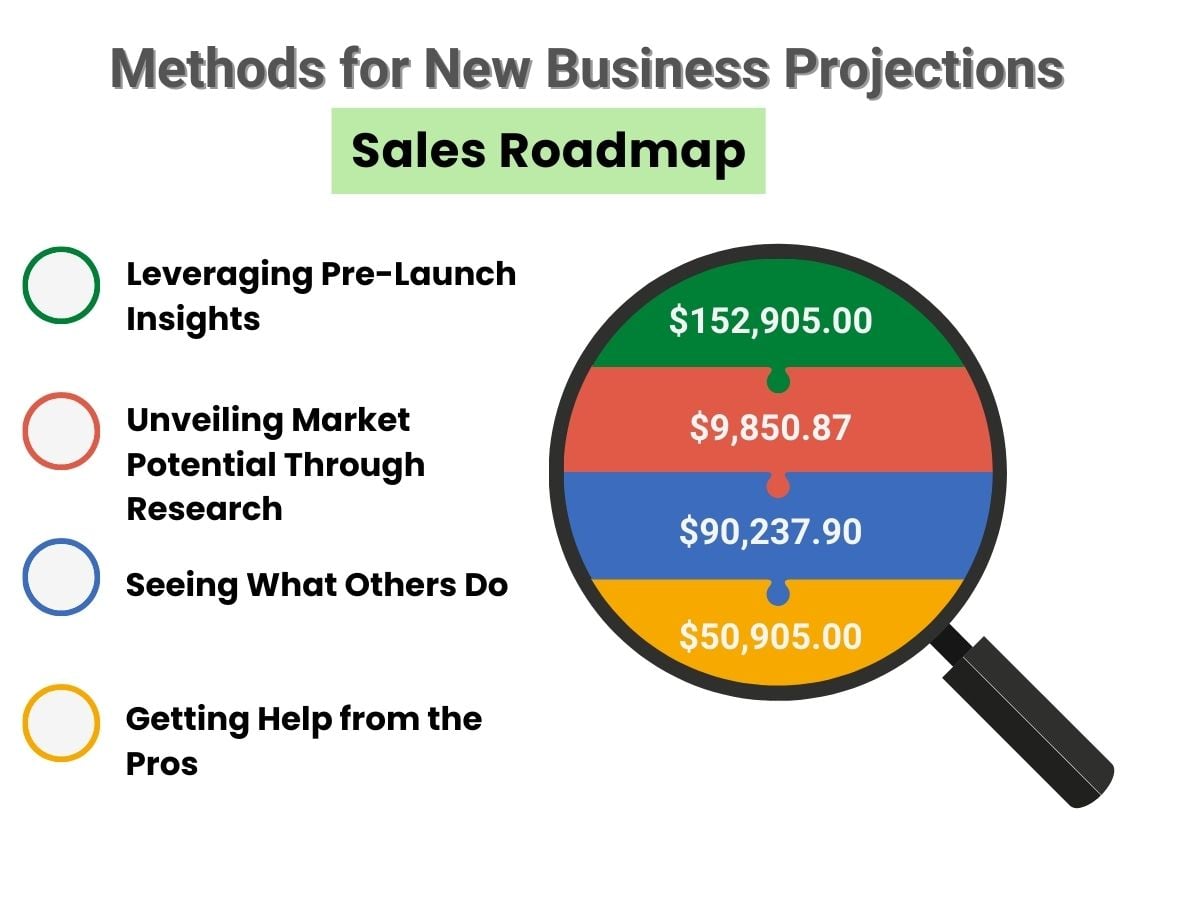
Crafting a Reliable Sales Roadmap: Methods for New Business Projections
Projecting sales for a new business can feel like navigating uncharted territory. While there's no single guaranteed method, several approaches can equip you with a reliable roadmap, informing your sales strategy and planning from the outset. Here are key methods to consider:
1. Leveraging Pre-Launch Insights
If you have limited data, don't underestimate the value of pre-launch activities. Utilize insights from pre-orders, beta testing, or market research surveys to establish a foundational baseline for your sales projections. These initial engagements offer valuable glimpses into customer response and potential market demand.
2. Unveiling Market Potential Through Research
Market research acts as a powerful tool for uncovering the hidden potential within your target market. Utilize market research reports, industry data, and customer surveys to estimate the overall market demand and your potential share of that pie. By understanding the market size and growth trajectory, you can make informed assumptions about your own sales potential.
3. Seeing What Others Do:
Gain valuable insights from established businesses in your industry. Look at the sales performance of similar companies, especially those in their early stages of growth. While copying their numbers might not work for you, you can use their data as a starting point.
Adjust their figures based on your unique situation, like your specific market and business model, to create a more realistic projection for your own venture.
4. Getting Help from the Pros:
Don't hesitate to ask experienced business people, consultants, or industry experts for advice. They know a lot and can help you make your sales predictions better, matching what's happening in the market now. When you listen to their ideas and experiences, it makes your sales plan stronger.
To make good sales predictions, mix different ways of doing it, making them fit your business well, and keep updating them as you learn more about what's happening in the market. When you start like this, you'll have a clear plan and use facts to guide how you sell things and plan for your business.
Building Your Sales Projection Model: A Step-by-Step Guide
Now that you've gathered your research, it's time to build your sales projection model, like a roadmap for your future sales. Here's a simplified guide to help you get started:
1. Setting Your Sights: Define Your Sales Goals
Imagine your desired sales numbers. What do you realistically hope to achieve within a specific timeframe, like a month, quarter, or year? Set both ambitious and achievable goals to give yourself a target to strive for by using a guide to sales goal templates.
2. Tracking Your Progress: Choose Key Performance Indicators (KPIs)
Think of KPIs as your measuring tools. They'll help you track how close you're getting to your sales goals. These might include:
- Conversion rate: How many people who see your product or service actually buy it?
- Average order value: How much does a typical customer spend?
- Customer acquisition cost: How much does it cost to acquire a new customer?
- Customer lifetime value: How much revenue can you expect from a customer over time?
3. Choosing Your Forecasting Technique: Picking Your Path
There are different ways to estimate your sales, like:
- Top-Down Approach: Imagine the whole market as a pie. This approach takes the total market size and estimates your slice based on market research and industry data.
- Bottom-Up Approach: Build your sales estimate from the ground up. Consider the size of your sales team, their average sales per person, and how likely they are to convert leads into customers.
- Combination Approach: Why not use both methods? This approach combines the insights from both top-down and bottom-up approaches to get a more complete picture.
4. Making it Easier: Utilize Tools and Templates
No need to start from scratch! There are plenty of free and paid sales forecasting software and spreadsheet templates available online. These tools can help you create your model faster and make it easier to visualize your data.
Your sales projection model is a living document. As you gather real-world data and learn more about your market, you can update and refine your projections to reflect the latest information. This will help you stay on track and make sound decisions for your new business.
Keeping Your Sales Projections on Track
Remember, your sales projections are not set in stone. As your business grows and you learn more, you'll need to adjust them accordingly. Here's how:
1. Check Your Progress Regularly
Keep an eye on your key performance indicators (KPIs), like conversion rates and average order value. Do your actual sales numbers match what you projected? If not, it's time to adjust your projections.
2. Ask Your Customers
Talk to your customers! Get their feedback through surveys, reviews, or conversations. What do they like about your product or service? What could be improved?
Use their insights to understand their needs and adjust your sales projections accordingly.
3. Stay on Top of What's Happening
The world around you is constantly changing. Keep up with industry trends, what your competitors are doing, and any economic changes that might affect your sales. This information can help you adjust your sales projections as needed.
By following these steps, you can ensure your sales projections are realistic and reflect the current state of your business. This will help you make informed decisions and keep your business on track for success.
Projecting Sales for New Businesses: Your Guide to a Brighter Future
Launching a new business is an exciting yet challenging journey. Amidst the whirlwind of tasks, one crucial aspect stands out: projecting sales. This article has equipped you with the knowledge and tools to navigate this critical step.
Sales projections are your roadmap to success. They guide financial decisions, resource allocation, and overall business viability. By following the steps outlined here, you'll be well on your way to creating a reliable sales projection for your new venture.
🟥Here's a quick recap:
🔥Gather information: Conduct market research, understand your target audience, and analyze your competition.
🔥Choose your forecasting method: Top-down, bottom-up, or a combination, depending on your data availability.
🔥Set realistic goals: Aim high but stay grounded, using your projections as a roadmap.
🔥Track your progress: Monitor key performance indicators (KPIs) and adjust your projections as needed.
🔥Stay adaptable: Be prepared to update your projections based on market changes and customer feedback.
As the wise Henry Ford once said, "If you're not growing, you're dying." By using sales projections effectively, you can ensure your new business thrives and flourishes in the ever-evolving market landscape.
So, go forth, entrepreneur, and chart your course to success!
Discover the Right Tools for Your Startup
Take our 2-minute quiz to find tools tailored to your specific needs and goals.
Take the QuizTakes only 2 minutes


