
Creating Strong Customer Relationships: Entrepreneurs Guide
Discover the essential steps to building and nurturing strong customer relationships. Learn how to understand your customers, develop effective communication strategies, and leverage customer feedback to foster loyalty and success.

In today's fiercely competitive business landscape, a strategic focus on establishing and nurturing robust customer relationships is vital to the prosperity and longevity of any entrepreneurial endeavor.
This comprehensive guide will take an in-depth look into a well-charted journey towards building, maintaining, and augmenting such relationships, step-by-step.
Through understanding your customers, formulating effective communication strategies, fostering trust, curating personalized experiences, leveraging customer feedback, and implementing proven customer retention strategies, entrepreneurs can both establish, and further, a loyal customer base leading to consistent business growth.
Understanding Your Customers
Creating strong customer relationships starts with an in-depth understanding of your target markets. Identifying diverse segments of potential customers helps in molding your products or type of business to cater to various customer needs, tastes, and expectations. Understanding customer demographics, for instance, a retail business planning format could include narrowing down on specific customer age-groups to cater better to clothing preferences.
Market analysis is crucial in this step, a feature-rich incorporation into a business plan can provide significant insights about potential customers through customer data analytics.

Developing a Communication Strategy
✳️ Test and Modify Your Communication Strategy
Communication is not a one-size-fits-all deal. As you craft your strategy, be open to adjustments. Always remember to track and analyze the performance of your communication channels and messages to see what's working or not working.
Consider using digital tools such as Google Analytics, MailChimp for email marketing analytics, or Hootsuite for social media performance. These tools will provide data on click-through rates, engagement rates, conversion rates, etc., allowing you to make data-driven decisions.
By continuously testing and refining your approach, you ensure your communication strategy remains effective and relevant, meeting not only your business goals but also your customers' evolving needs and expectations.
This process of trial and error will help you to optimize the different techniques and find the best mix that favors all your target demographics. A well-analyzed and properly implemented communication strategy can result in higher engagement, brand recognition, and ultimately, increased revenue.
Building Trust and Credibility
Further, building trust means always being there to address your customers' needs and answering their queries promptly, thereby establishing your business as reliable. It also includes being accountable and honest about your mistakes – if a customer encounters an issue, own up it and work actively towards resolving it.
Trust can also be fostered through customer involvement, such as incorporating their feedback into your product development process. It shows that you value their opinion, which strengthens their trust in your brand.
For instance, Buffer, an innovative social media management tool, shines as an example of upholding transparency and trust-building. Early on, they made a daring move by publicly sharing their salaries and revenue formula, a transparent practice that significantly bolstered both employee and customer trust. Their transparency reports continue to be an integral part of their commitment to maintaining credibility amongst their audience. Matter-of-factly, they won their customers' trust by letting them have a peek into their internal operations.
The synthesis of transparency, accountability, reliability, and customer involvement in your business practices promotes trust and credibility, fostering enduring customer relationships.
Personalizing Customer Experiences
In the era of mass-production and monotonous services, individual attention and personalized experiences have become deciding factors in a potential customer's purchase journey. Personalizing interactions, product range, and services can lead to memorable experiences that foster loyalty and satisfaction.
Integrating collected data into customer service interactions, email marketing campaigns, or while recommending products/services can transform standard transactions into exceptional experiences that customers cherish, positioning your brand prominently in their minds.
Take, for example, the phenomenal success story of Netflix, a leading online streaming platform. Netflix has built a loyal subscriber base with its highly personalized experience. It adopts a sophisticated recommendation system powered by customer viewing history and preferences.
Coupled with tailor-made promotional content and personalized content catalog, Netflix ensures every single user feels like the content is uniquely curated for them. This level of customization has led to increased user engagement and has contributed significantly to Netflix's immense popularity.
By taking the path of personalizing customer experiences, you are essentially telling your customers that 'you matter,' making them feel valued, esteemed, and ultimately, loyal towards your brand. In a world where customers are continually being bombarded with generic advertising, personalization can be your secret weapon to stand out and create a lasting impression.
Leveraging Customer Feedback
Feedback is the mirror that truthfully reflects your business image. Collecting and incorporating customer feedback ensures that you can tweak your business strategies to better suit customer preferences. Methods for gathering feedback can range from simple tools like online surveys to more intricate methods like analyzing customer behavior. Zappos, renowned for its high-comfort footwear, makes excellent use of customer feedback to continually refine its product offerings.
How to Leverage Customer Feedback Effectively: 5 Quick Steps
⏹️ Create a System for Gathering Feedback:
Use tools such as online surveys, feedback forms, social media channels, or review platforms to collect customer feedback. You can also consider direct methods like personal emails or phone calls.
⏹️ Identify Key Metrics:
Define what you want to measure. It could be customer satisfaction (CSAT), net promoter score (NPS), or customer effort score (CES). Knowing what you aim to measure makes analyzing feedback more manageable.
⏹️ Analyze Feedback Data: After collecting responses, it's time to dive into the data. Look for common patterns, recurring complaints, or areas of praise. Remember, negative feedback is just as valuable as positive - it pinpoints areas where you can improve.
⏹️ Implement Changes and Strategies Based on Feedback:
Once the feedback is analyzed, you should implement the required changes. Be it tweaking your product, revising your service standards, or innovating your marketing techniques - let the feedback guide your improvements.
⏹️ Communicate Back to Your Customers: Inform your customers of the changes you've made based on their feedback. This shows that you value their input, strengthening their relationship with your brand.
The goal is to improve based on what customers are saying about your business. Like Zappos, don't hesitate to take a proactive approach towards customer feedback to continually refine your customer experience.
Retention Strategies and Customer Loyalty
Cultivation of customer loyalty plays an instrumental role in devising customer retention strategies. The advantages of loyalty programs include repeat sales and the transformation of loyal customers into brand advocates. Starbucks' 'Rewards' program is an excellent example of a successful loyalty program encouraging repeat visits and customer retention.

How to Develop Retention Strategies and Boost Customer Loyalty: 5 Key Steps
✅ Offer Irresistible Loyalty Programs: Create a reward program that incentivizes repeat business and is easy for customers to join. Offer meaningful rewards that are simple to earn and redeem, such as exclusive discounts or even tangible gifts.
✅ Personalize Communications: Send personalized emails or messages to your customers using their interests, past purchases, and interactions with your brand. Tailored communication makes customers feel acknowledged and valued.
✅ Engage Actively on Social Media: Foster regular communication with your customers on various social media platforms. Respond promptly to their comments, messages, or concerns. Openly appreciate their feedback and showcase your authentic gratitude.
✅ Offer Superior Customer Service: Excel in customer service by addressing concerns quickly, providing hassle-free returns or exchange policies, and actively listening to customers' needs. Great customer service enhances satisfaction and loyalty.
✅ Continuously Improve and Innovate: Continually evolve your offerings, services, and experiences based on customer feedback to create a consistently delightful experience that keeps customers coming back.
A shining example of customer retention success is Starbucks' 'Rewards' program. This customer-centric loyalty program encourages frequent patronage by offering customers free drinks, food, custom offers, and invitations to exclusive events.
Understanding customers' needs and preferences, Starbucks has effectively curated a retention strategy that keeps them loyal and consistently engaged with their brand.
Cultivating Customer Relationships through CRM
For entrepreneurs, CRM systems serve as indispensable tools to not only systemize customer interactions but also to bolster relationship-building efforts effectively. By streamlining various processes and providing valuable insights into customer behavior, the CRM system enables you to cultivate and manage customer interactions in more engaging and personalized ways.
How to Maximize CRM's Potential to Build Strong Customer Relationships: 5 Essential Strategies
🔹 Ensure Seamless Integration:
To make the most of your CRM system, integrate it with your existing tools like marketing automation platforms, social media management software, and customer support systems. Seamless integration allows your CRM to work in harmony with your other tools, providing a comprehensive view of your customers.
Use your CRM system to segment customers based on factors such as demographics, preferences, or purchase history. Apply these insights to target customers more effectively with tailored marketing campaigns and personalization efforts.
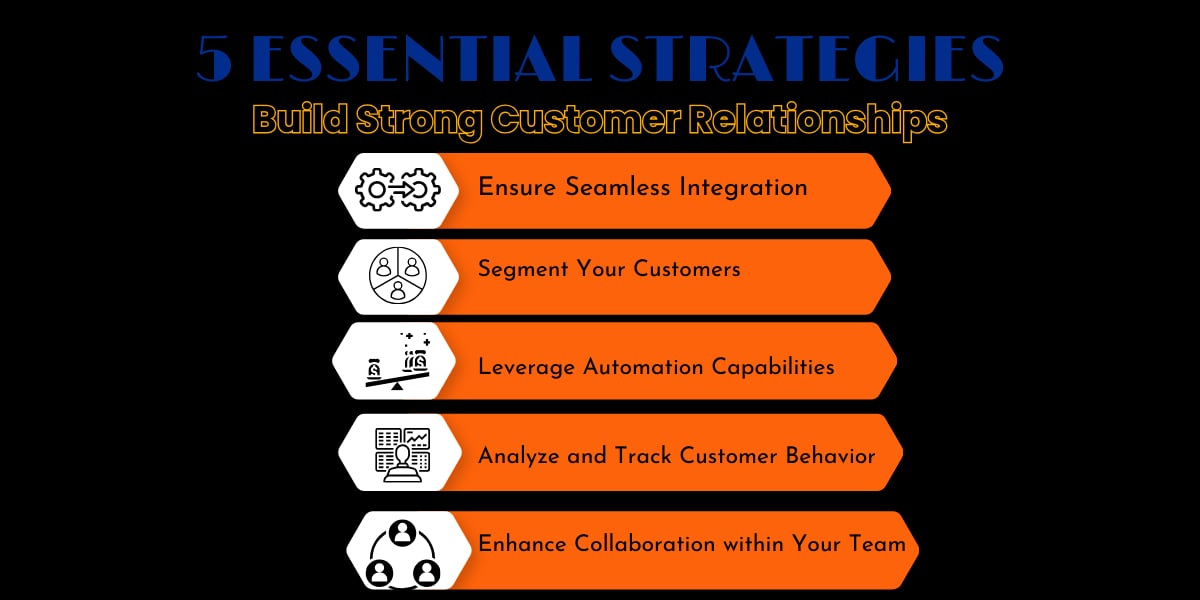
🔹 Leverage Automation Capabilities:
Automate repetitive or time-consuming tasks, like sending follow-up emails or updating contact information, freeing up more time to focus on high-quality customer interactions and building relationships.
🔹 Analyze and Track Customer Behavior:
Utilize the CRM system to analyze data on customer behavior, preferences, and history. These insights can help you identify sales opportunities, improve customer experiences, and nurture relationships proactively.
🔹 Enhance Collaboration within Your Team:
Encourage collaboration by sharing valuable customer information with your sales, marketing, and support teams. This enables your team members to have a unified understanding of customers, fostering more meaningful, and coherent customer interactions.
CRM systems not only prove beneficial in organizing and managing customer data, but they also empower you to create highly engaging customer experiences and optimize numerous touchpoints, which in turn fortifies your customer relationships.
By implementing these strategies, entrepreneurs like you can unlock the true potential of your CRM system, making it a cornerstone for lasting and robust customer relationships that serve as a catalyst for your business success.
Harnessing the Power of Customer Relationships: A Conclusion for New Entrepreneurs & Startups
Building a business can feel like launching a rocket – complex, scary, and full of unknowns. But here's the secret fuel you need: your customers! Think of them as your loyal rocket crew, always ready to cheer you on.
But how do you make them love your business? Here's the plan:
1. Spy Mission: Before anything, get to know your crew! Do some market research: who are they, what do they like, what problems do they have? Think of it as a detective adventure uncovering their secrets!
2. Make a Promise: Now, craft a mission statement that's your team's motto. What kind of business do you want to be? Fun, helpful, reliable? Let your customers know what they can expect!
3. Win Their Hearts: Treat your customers like VIPs! Offer personalized experiences, listen to their feedback, and build trust by always keeping your promises. It's like making new friends at a party!
4. Long-Term Party: Building relationships takes time and effort. Think of it as planting a friendship tree – you water it every day, and eventually, it grows strong and tall.
5. Superpower Feedback: Feedback isn't a monster under the bed; it's a treasure map! Use it to improve your business and make your customers even happier. The more feedback you get, the better your rocket flies!
Discover the Right Tools for Your Startup
Take our 2-minute quiz to find tools tailored to your specific needs and goals.
Take the QuizTakes only 2 minutes


