
Customer Surveys: Valuable Insights for Your Business
Unlock your business's potential with customer surveys. Learn how to glean valuable insights, craft effective customer surveys, spur innovation, and achieve long-term success. Discover more!

In the competitive business landscape, grasping customer needs is vital for entrepreneurs to stay ahead. Customer surveys serve as a valuable tool, informing strategic choices.
This comprehensive guide will delve into the significance and advantages of surveying customers, explore various survey methodologies, provide practical tips for crafting effective surveys, showcase real-life examples of success, address common challenges to avoid, and offer actionable guidance on analyzing and interpreting survey results.
The Importance and Benefits of Surveying Customers
Customer surveys emerge as a powerful tool, empowering businesses to gather invaluable insights that inform strategic decision-making and propel growth.
Through customer surveys, businesses can effectively gauge customer satisfaction, identify areas for improvement, and uncover hidden opportunities. By directly engaging with their target audience, businesses gain a deeper understanding of their customers' perceptions, pain points, and aspirations. This wealth of information proves instrumental in shaping product development, marketing strategies, and customer service initiatives.
Gain Insights into Customer Needs and Preferences: Surveys enable entrepreneurs to gather direct feedback from their target audience, understanding their likes, dislikes, and pain points. This informs effective product development, customer service improvements, and the creation of targeted marketing campaigns.
Identify Areas for Improvement: Customer surveys help identify areas where a business can enhance its products, services, or operational processes, leading to increased customer satisfaction and loyalty.
Enhance Customer Satisfaction and Loyalty: Regularly surveying customers shows a genuine interest in their opinions and desires, fostering a strong customer-business relationship, and increasing the likelihood of repeat business and positive word-of-mouth referrals.

Types of Customer Surveys and Effective Survey Techniques
Customer surveys come in a variety of formats and can be used to gather feedback on a wide range of topics. Some common types of customer surveys include:
✅ In-Person Surveys: Ideal for gathering extensive qualitative feedback, in-person surveys allow entrepreneurs to build personal connections and establish rapport with customers. Tips for conducting effective in-person surveys include active listening, open-ended questions, and selecting suitable locations.
✅ Online Surveys: With the advent of technology, online surveys have become a popular way to collect both quantitative and qualitative data. Designing user-friendly surveys with clear and concise questions, avoiding leading questions, and offering incentives for participation can substantially increase response rates.
✅ Telephone Surveys: Telephone surveys offer a convenient way to connect with customers while maintaining a personal touch. Implementing a well-structured script, being mindful of time limits, and training surveyors for consistency and empathy are crucial to success.
Real-Life Examples of the Impact of Customer Surveys
Look at these exciting stories that show how powerful customer surveys can be:
Example 1: Let's take a look at a company we'll call 'Company X'.
They wanted to make their products even better, so they asked their customers what they thought through surveys. Guess what? They listened to the feedback, made some changes, and it really paid off big time! Their customers were 20% happier with the product than before, and they even boosted their sales by 15%.
Example 2: Now, meet 'Entrepreneur Y'.
She was super smart in using customer surveys to truly understand what colors, flavors, styles, or features the customers of her target market would love the most. Then, she shaped her marketing campaigns around these preferences. With this smart move, she managed to double the number of her customers in just six short months!
Avoiding the Pitfalls of Customer Surveys
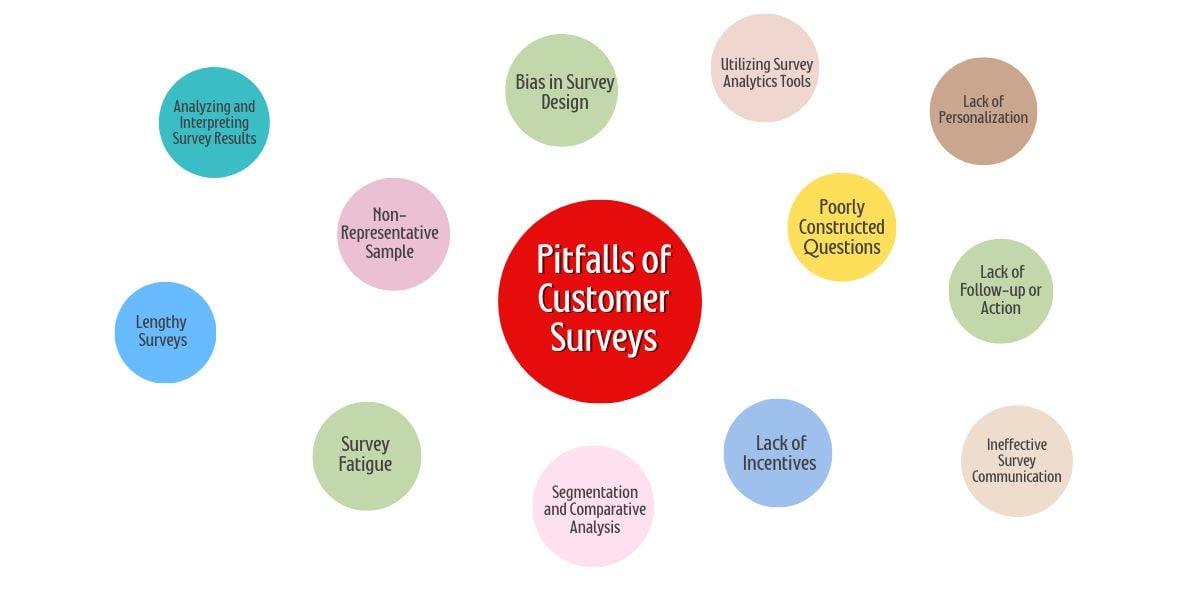
Customer surveys are a valuable tool for businesses of all sizes to gather feedback from their customers. However, if not done properly, customer surveys can be ineffective and even harmful. In this guide, we will discuss the most common pitfalls of customer surveys and how to avoid them.
⛔ Survey Fatigue: Customers may feel overwhelmed if bombarded with too many surveys. Avoid this by strategically choosing when and how often to survey.
⛔ Poorly Constructed Questions: Asking vague, leading, or complex questions can confuse respondents and dilute the accuracy of survey results. Providing clear instructions and using scaled-response questions can mitigate this issue.
⛔ Lack of Incentives: Offering attractive incentives, such as discounts, freebies, or the chance to win a prize, encourages customer participation and increases survey response rates.
⛔ Non-Representative Sample: One common mistake is surveying a sample of customers that does not accurately represent the entire customer base. This can result in biased and misleading survey results. To avoid this, it is important to ensure that the survey sample is a true representation of the target population.
⛔ Lengthy Surveys: Customers may lose interest or abandon the survey when faced with a lengthy and time-consuming questionnaire. Keeping surveys concise and focused only on necessary information can help maintain customer engagement and participation.
⛔ Lack of Personalization: Generic and impersonal surveys can make customers feel disconnected and less motivated to provide meaningful feedback. Adding personal touches, such as addressing customers by name or referencing previous interactions, can create a more personalized experience and increase the chances of obtaining valuable insights.
⛔ Bias in Survey Design: Biased wording or response options in survey questions can influence how customers respond and lead to skewed results. It is important to design surveys with unbiased language and provide neutral response options to ensure accurate and unbiased feedback.
⛔ Ineffective Survey Communication: Poorly communicated survey invitations or reminders can result in low response rates. Clear and concise communication, including explaining the purpose and value of the survey, can help improve participation and engagement.
⛔ Lack of Follow-up or Action: Failing to communicate survey results or taking action based on customer feedback can lead to decreased trust and participation in future surveys. It is essential to share survey findings and let customers know how their feedback has contributed to improvements or changes.
⛔ Analyzing and Interpreting Survey Results
Analyzing and interpreting survey results is the process of transforming raw survey data into actionable insights that can inform business decisions, improve customer satisfaction, and drive growth. It involves a series of steps, like data cleaning, visualization and interpretation.
⛔ Utilizing Survey Analytics Tools: Popular survey tools like SurveyMonkey and Google Forms offer built-in data analysis features. Leveraging these tools can help entrepreneurs quickly analyze and interpret survey results, identifying trends, and making informed business decisions.
⛔ Segmentation and Comparative Analysis: Categorizing survey respondents based on demographics or other relevant criteria allows for targeted analysis, revealing unique insights and patterns among different customer groups.
Recent Trends and Best Practices in Customer Surveying
The way companies gather feedback from customers is changing rapidly. This is because customers are behaving differently, new technology is available, and companies need to get more out of the feedback they collect. To keep their customer surveys effective, companies need to stay up-to-date on the latest trends and best practices.
Here's a quick overview of what's happening in customer surveying and what companies can do to make sure their surveys are working.
📋 Personalization
Making surveys personal is really important to get more people to fill them out and to get results that are true. If a company shapes the survey to match the people it's targeting, it can improve their experience and give the company more useful information.
Personalizing can be as simple as using the customer's name, asking questions relevant to their past experiences, or even changing the language of the survey to what the customer speaks best.
📋 Multi-channel survey distribution
Today's customers use multiple digital platforms daily - social media, emails, websites, and mobile apps, to name a few. It is crucial to adopt a multi-channel approach for survey distribution to reach the target audience effectively. By meeting customers where they are most active and comfortable, organizations can drive higher engagement and better survey response rates.
📋 Mobile optimization
With so many people using smartphones, it's important to make sure surveys are easy to take on mobile phones. Surveys should be designed with mobile in mind, meaning they should be easy to read, navigate, and answer, even on a small screen. This means using big fonts, making it easy to scroll, and only asking one question per page. By making surveys mobile-friendly, more people will be able to take them, and you'll get more responses.
📋 Real-time feedback
As customer preferences and needs evolve, real-time feedback becomes more valuable in meeting their expectations. Implement tools that allow organizations to capture feedback instantly, such as live chat, in-app surveys, and SMS-based surveys. This instantaneous feedback can enable companies to address customer concerns, suggest solutions, and improve their products or services promptly.
📋 Integration with Customer Relationship Management and data analytics tools
The insights gathered through customer surveys become exponentially more valuable when integrated with customer relationship management (CRM) systems and data analytics tools. By building a comprehensive understanding of customer preferences, feedback, and behaviors, companies can make well-informed decisions to improve their offerings and deliver excellent customer experiences.
📋 Closed-loop feedback systems
A closed-loop feedback system means asking customers for their opinions, looking at what they say, making changes based on their thoughts, and telling the customers about those changes. This way, customers know that the business cares about their opinions and uses them to get better. Doing this well helps to make customers stay loyal and gives the organization a good reputation.
📋 Leveraging artificial intelligence (AI) and machine learning (ML)
Computers can now understand big amounts of data way faster than humans can. They can find patterns in the data and show businesses what customers are really thinking.
Artificial Intelligence (AI) and Machine Learning (ML) are cool computer programs that can look at lots of information, find what's important, and help businesses learn about what their customers like. When companies use AI to study customers, they can know what customers feel and even guess what they might do in the future. This helps businesses make smart choices and give each customer the special treatment they deserve.
Example Template for a Customer Survey with Sample Questions
Customer Satisfaction Survey Template
Introduction:
Thank you for taking the time to participate in our Customer Satisfaction Survey. Your feedback is valuable to us as it helps us improve our products and services. This survey will take approximately 5 minutes to complete.
Please note that your responses will remain confidential and will be used for internal analysis purposes only.
Survey Questions
1. How would you rate your overall satisfaction with our product/service?
🔾 Please choose one option.
🔾 Very satisfied
🔾 Satisfied
🔾 Neutral
🔾 Dissatisfied
🔾 Very dissatisfied
2. How likely are you to recommend our product/service to a friend or colleague?
Please choose a rating from 0 to 10, where 0 is not likely at all, and 10 is extremely likely.
(0 - 10)
3. Did our product/service meet your expectations?
Please choose one option.
Yes, it exceeded my expectations
Yes, it met my expectations
No, but it was okay
No, it did not meet my expectations

4. How easy was it to use or navigate our product/service?
Please rate the user experience.
🔾 Very easy
🔾 Fairly easy
🔾 Neutral
🔾 Fairly difficult
🔾 Very difficult
5. How helpful was our customer support?
If you have contacted our customer support, please rate your experience.
🔾 Very helpful
🔾 Somewhat helpful
🔾 Neutral
🔾 Not very helpful
🔾 Not at all helpful
🔾 Not applicable (I have not contacted customer support)
6. What specific improvements would you like to see in our product/service?
Please list any suggestions, features, or enhancements that you believe would improve your experience.
(Open-Text Response)
7. Do you have any other comments or feedback for us?
Please share any additional comments or feedback that could help us improve our product/service.
(Open-Text Response)
Conclusion:
Thank you for taking the time to complete our survey. We appreciate your feedback and will use your responses to enhance our customer experience. If you have any questions or concerns, please feel free to contact our customer support team.
Empowering Businesses through Customer Surveys
Conducting customer surveys is an indispensable strategy for entrepreneurs and emerging businesses. It gives them valuable information that can help them improve their products, make their customers happy, and stand out from the competition.
Smart entrepreneurs know that customer surveys are super important. They use them to understand what their customers want and need, so they can create products and services that people actually love. This helps them stay ahead of the competition and win more customers.
The more often you do customer surveys, the more information you'll have about your customers. This information is like a treasure map that can help you find success.
Don't be afraid of negative feedback! It's an opportunity to learn and improve. Every customer has different preferences, and even negative feedback can help you understand what some people don't like about your products or services.
The more often you do customer surveys, the more information you'll have about your customers. This information is like a treasure map that can help you find success. Don't forget to ask your customers for their feedback, even if you're afraid of what they might say. Remember, negative feedback is just as important as positive feedback in helping you grow your business.
Regularly conducting surveys provides businesses with up-to-date customer feedback, helping them identify areas needing improvement, track trends, and measure the impact of changes made based on previous feedback. This iterative process ensures that businesses stay relevant and responsive to customer needs and expectations, paving the way for long-term success.
Discover the Right Tools for Your Startup
Take our 2-minute quiz to find tools tailored to your specific needs and goals.
Take the QuizTakes only 2 minutes


