
Reaching the Right Audience: Guide to Customer Targeting
Discover the power of customer targeting for business success. Learn comprehensive strategies to identify, connect, and engage your ideal customers effectively.

In the fast-paced world of business, understanding and effectively reaching the right audience is vital for success. This comprehensive guide on customer targeting will equip entrepreneurs and individuals interested in starting a new business with the necessary strategies to identify and connect with their ideal customers.
Understanding Customer Targeting and Its Significance
Delve into the world of customer targeting and discover why it's crucial in today's business landscape. Customer targeting involves focusing marketing efforts on a specific group of people most likely to be interested in a brand's offerings. This targeted approach allows businesses to tailor their marketing messages to match specific customer preferences and needs. Not only does this optimize resource allocation, but it also leads to highly impactful marketing campaigns.
Key Techniques for Customer Segmentation
Effective customer targeting relies on a variety of segmentation methods. This section explores demographic, psychographic, and behavioral segmentation strategies, highlighting how they empower brands to better understand and cater to the unique characteristics and behaviors of their target consumers.
Armed with this knowledge, businesses can craft personalized and relevant marketing campaigns, significantly increasing their chances of attracting and retaining these customers.
The Benefits of Customer Targeting
Witness the measurable benefits that come with effective customer targeting. When businesses accurately identify and engage their ideal customers, it translates to higher sales and conversion rates. When companies figure out and connect with just the right people who love their products or services, they get to enjoy more sales and happy customers.
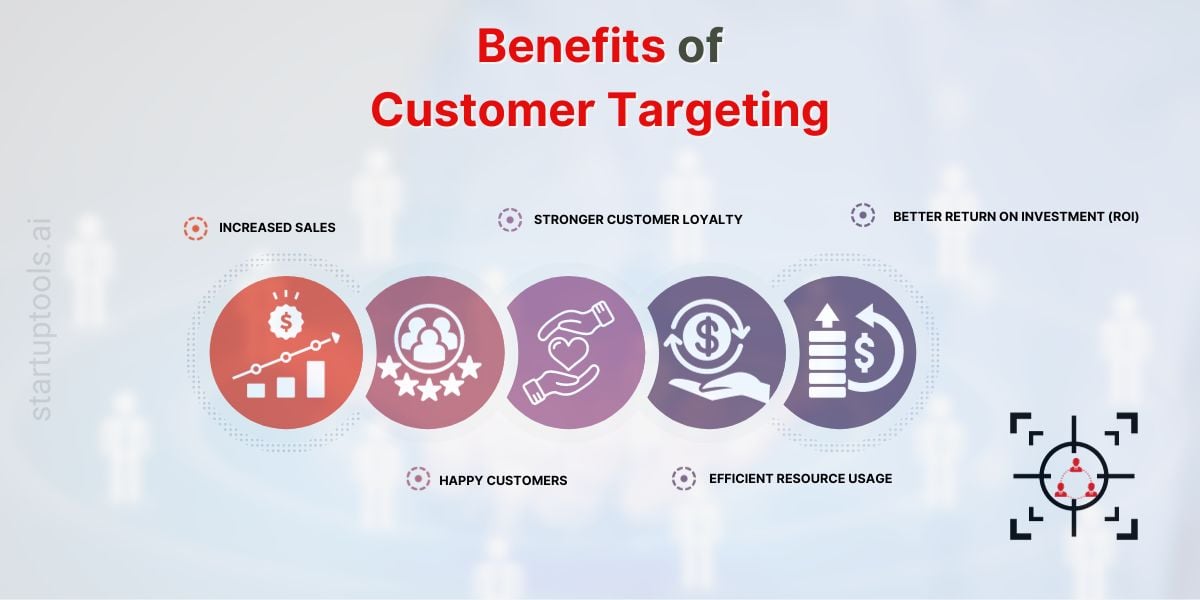
This perfect match also makes customers feel special and appreciated by the brand, which helps create a special bond between them. Plus, it's a clever way of using resources wisely, and this helps businesses get the most out of their efforts and money spent.
With the right customer targeting, companies can experience:
✅ Increased sales: Connecting with people who are genuinely interested in their products or services can boost the company's sales numbers.
✅ Happy customers: Accurate customer targeting helps create satisfied customers since products and services meet their specific needs and preferences.
✅ Stronger customer loyalty: Taking the time to understand and connect with customers can make them feel special and appreciated, which encourages them to continue supporting the brand.
✅ Efficient resource usage: By focusing efforts on the right people, businesses avoid wasting time and money on less effective marketing strategies.
✅ Better return on investment (ROI): Companies can maximize the effectiveness of their marketing efforts, leading to higher returns from their promotional investments.
Case Studies Demonstrating the Power of Customer Targeting
Gain tangible proof of customer targeting's effectiveness through case studies and success stories from various industries. These real-world examples provide a clear picture of how accurate customer targeting can fuel significant business growth.
Here are some sample tips:
▪ Showcase a diverse range of case studies. Include examples from various industries, company sizes, and geographic locations to demonstrate the applicability of customer targeting across a broad spectrum of businesses.
▪ Highlight specific achievements and metrics. Quantify the impact of customer targeting by presenting concrete results, such as increased sales, improved customer engagement, or enhanced brand perception.
▪ Emphasize the process and strategies used. Provide insights into the customer targeting strategies employed in each case study, allowing readers to understand the underlying principles and replicate successful approaches.
▪ Include testimonials from key stakeholders. Incorporate quotes from executives, marketing managers, or customers to provide firsthand perspectives on the effectiveness of customer targeting initiatives.
▪ Structure the case studies in a compelling manner. Use storytelling techniques, engaging visuals, and clear messaging to make the case studies informative and memorable.
Practical Tips for Identifying and Analyzing Target Customers
In the vibrant world of business, knowing your customers is equivalent to climbing the first rung of the ladder to success. It's like being on a treasure hunt where you're trying to find the most precious gem - 'Your Target Customer'. If you've been wondering how to find these gems and make them love your brand, you're in luck!
Whether you're making artisanal honey, selling biodegradable coffee pods, or offering a pet grooming service, understanding who your ideal customers are will help guide your business strategies and propel you towards success. Let's dive in and learn how you can navigate the exciting terrain of customer identification and analysis!
✔️ Know your product or service inside and out.
Before you start thinking about who your target customers are, you need to have a deep understanding of what you're selling. What problem does your product or service solve? Who benefits the most from it? Once you know your product or service well, you can start to identify the types of people who are most likely to be interested in it.
✔️ Do your research.
There are many sources of information that can help you learn about your target customers. You can talk to people who use your product or service, read industry reports, and look at online data. The more you know about your target customers, the better you can tailor your marketing messages to them.
✔️ Create buyer personas.
A buyer persona is a fictional representation of your ideal customer. This might sound a little funny, but it's super helpful.
A 'Buyer Persona' is like creating an imaginary friend - but this friend represents your ideal customer. You give them a name, age, interests, and more, based on what you've figured out about your target customer. This can help you get a clearer picture of who you’re trying to sell to.
✔️ Use social media.
Social media is a great way to connect with potential customers and learn more about them. You can use social media to listen to what people are saying about your product or service, to see what kind of content they're interested in, and to get feedback on your marketing campaigns.
✔️ Pay attention to your analytics.
If you have a website or online store, you can use analytics tools to track your visitors' behavior. This information can help you to learn more about your target customers, such as what pages they're most interested in and what kind of content they're most likely to engage with.
✔️ Check Out Your Competition
Look around to see who is buying similar products. By checking out what types of customers other successful businesses have, it gives you a sense of who might be interested in what you're selling.
✔️ Listen and Learn
Once you start selling, listen to what your customers have to say. Do they like your products? Do they have suggestions for improvements? This feedback is super valuable and can help you tailor your products to better match what your customers want.
✔️️ Keep testing
Remember, your first idea of who your ideal customer is might not be totally accurate. That's okay! Just keep trying new things, and pay attention to what works and what doesn't.
Here are some additional tips for identifying and analyzing target customers:
✦ Use surveys and polls.
✦ Run focus groups.
✦ Talk to your customers directly.
By following these tips, you can learn more about your target customers and make sure that your marketing campaigns are reaching the right people.
Revolutionize Your Startup's Customer Targeting Strategy
Entering the world of business as a startup entrepreneur can feel a bit like stepping onto a roller coaster. Alongside the exhilaration of carving out your niche and growing your brand, comes the challenge of reaching the right customers.
Fortunately, technology and analytics have emerged as phenomenal game-changers for customer targeting in the business realm. As a new business owner, embracing these tools can be your ticket to a smoother and more thrilling entrepreneurial ride.
🟪 The Tech-Savvy Approach to Customer Targeting
Gone are the days where businesses had to rely exclusively on traditional marketing techniques and gut instincts to connect with their desired audience. The advent of technology has forever changed the landscape of customer engagement. Ranging from Customer Relationship Management (CRM) systems to Artificial Intelligence (AI) and machine learning tools, a mammoth of technologies exists to help startups like yours tap into the powerful realm of customer targeting
🟪 Untangling CRM Systems
CRM systems are the GPS guiding you towards your ideal customers. CRMs allow you to gather, organize, and manage customer information all in one place. They can track consumer interactions across different platforms, providing a 360-degree view of how they experience your brand. For instance, platforms like Salesforce and Zoho CRM help you understand who your clients are, what they need, and how you can make them happy customers.
🟪 Leaning into AI and Machine Learning
AI and machine learning are revolutionizing the way we approach customer insights by allowing us to delve deeper into their behaviors and preferences than ever before. These powerful tools can analyze massive amounts of data, uncovering hidden patterns and trends that would be impossible to detect manually.
With AI-powered tools, businesses can gain predictive insights into future customer behavior. This means you can anticipate your customers' needs before they even arise, allowing you to proactively address them and foster long-lasting loyalty. Imagine being able to predict when a customer might need a product refill or when they're considering switching to a competitor. With this kind of foresight, you can tailor your marketing messages and offers to keep your customers happy and engaged.
🟪 Discovering your Ideal Customers with Analytics
You've probably heard the saying "knowledge is power." In the realm of customer targeting, that rings exceptionally true. Analytics tools dissect customer data and transform it into usable information, effectively equipping businesses with the knowledge to engage their ideal clients.
🟪 Mastering Segmentation with Analytics
Analytics tools offer invaluable help in customer segmentation - the practice of dividing customers into groups based on common characteristics like age, interests, spending habits, etc. Google Analytics, for instance, can track website traffic and user behavior, permitting startups to cluster customers according to their online habits leading to more targeted marketing approaches.
🟪 Understanding Predictive Analytics
Predictive analytics tools take it a step further. They use historical customer data to forecast future behaviors and trends. For instance, RapidMiner is a tool that can predict customer churn rate. With such insights, you can reframe your strategies to retain customers better.
Starting your own company can feel scary, especially when you think about using technology and data analysis. But, if used correctly, these tools are not just helpful; they can totally change the game. They can help you find the right customers, making decisions based on data instead of just guessing.
Overcoming Common Challenges in Customer Targeting
As a business owner, you may have to encounter and conquer several challenges that stand between you and your ideal customers. However, with every challenge comes an opportunity to grow and improve. Let's explore common difficulties faced in customer targeting and provides proven strategies to overcome these hurdles, ensuring your customer-centric efforts yield fruitful results.

🚨 Challenge #1: When Data Overwhelms
When it comes to customer targeting, data is undeniably your best friend. That is until you're bombarded with more data than you know what to do with. The sheer volume of customer data available could lead to confusion and misinterpretation.
Solution: Streamline and organize your data. Invest in robust data management tools and CRM systems like HubSpot or Zoho to help segregate, comprehend, and leverage the vast amounts of customer data. Regularly clean your database to maintain its relevance and usefulness.
🚨 Challenge #2: Identifying the Ideal Customer
Defining the 'ideal customer' can be challenging. Failing to do so might result in a lukewarm reception to your product or service due to a disconnect between what you offer and what your customer needs.
Solution: Create detailed buyer personas using demographic, psychographic, and behavioral data. These are semi-fictional characters that represent your potential customers. Understanding your buyer personas can guide your product development and marketing efforts, thereby increasing the chances of a successful customer match.
🚨 Challenge #3: Over or Under-targeting
Aiming too wide (over-targeting) could dilute the impact of your message, and zoning in too narrowly (under-targeting) might cause you to miss out on a larger audience.
Solution: Balance is key. Perform regular audits of your targeted marketing efforts to ensure they are not excessively broad or narrowly focused. Use analytics tools to continuously measure and refine your target audience approach.
🚨Challenge #4: Adapting to Changing Customer Needs
In today's fast-paced world, customer preferences and expectations change rapidly, making it hard to keep up.
Solution: Keep a close watch on market trends and changes in customer behavior. Utilize predictive analytics tools to anticipate future shifts in customer needs and align your offerings accordingly. Feature customer feedback in your strategy and remain flexible in adapting to these changes.
🚨 Challenge #5: Protecting Customer Privacy
As customer data gathering becomes more sophisticated, privacy concerns grow. Business owners must protect customer data to evade legal trouble and maintain trust.
Solution: Adhere to ethical and legal data collection guidelines. Be transparent with customers about how their data will be used and respect their privacy preferences. Using privacy-focused CRM software is also a viable option.
The path to effective customer targeting might come with its set of challenges. However, with a resilient mindset and the practical solutions mentioned above, these hurdles can be overcome. The outcome? A robust customer targeting strategy that hits the bullseye, paving the way for business growth and success.
The Importance of Regular Evaluation and Adaptation
In a dynamic business environment, resting on laurels is not an option. Regular evaluation and adaptation of customer targeting strategies are crucial steps toward maintaining a competitive edge. This action ensures that businesses can stay in sync with the ever-evolving consumer behaviors and industry trends.
Target Right, Win Big
Customer targeting is a vital component of any business's journey to success. By mastering the art of customer targeting, business leaders and aspiring entrepreneurs are empowered to reap numerous benefits, stay ahead of their competitors, and remain motivated in the face of constant change.
Focusing on customer targeting not only propels sales and business growth but also fuels the passion for delivering the best possible service and products. Equipped with the right tools, adapting to new methods, and regularly evaluating progress, businesses can forge lasting connections with their customers, driving success today and for years to come.
Discover the Right Tools for Your Startup
Take our 2-minute quiz to find tools tailored to your specific needs and goals.
Take the QuizTakes only 2 minutes


